

Dec-2025 Pegasystems PEGACPDC25V1 Certification Real 2025 Mock Exam
PEGACPDC25V1 Exam Questions and Valid PMP Dumps PDF
NEW QUESTION # 38
MyCo,a telecom company, recently introduced a new mobile handset offer, MyFone 14 Pro, for its premium customers. As the bank has financial targets to meet, the business decides to boost the MyFone 14 Pro offer.
As a decisioning architect, how can you ensure that the MyFonel4 Pro offer is prioritized over other offers7
- A. Increase the starting propensity of the MyFone 14 Pro offer.
- B. Increase the context weight of the MyFone 14 Pro offer.
- C. Increase the business value of the MyFone 14 Pro offer.
- D. Increase the business weight of the MyFone 14 Pro offer.
Answer: D
NEW QUESTION # 39
A customer qualifies for Standard card (priority 60), Rewards card {priority 40), and Premium card {priority
30). Standard card volume is exhausted. Rewards card has remaining volume, and Premium card has remaining volume. The system uses "Return any action that does not exceed constraint" mode.
Which actions does the customer receive in this scenario?
- A. Rewards card and Premium card as available actions
- B. Standard card only as highest priority action
- C. Premium card only as lowest priority available action
- D. No actions due to Standard card volume exhaustion
Answer: A
NEW QUESTION # 40
U+ Bank wants to offer credit cards only to customers with a low-risk profile. The customers are divided into various risk segments from AAA to CCC. The risk segmentation rules that the business provides use the Age and the customer Credit Score based on the following table. The bank uses a scorecard model to determine the customer Credit Score.
As a decisioning architect, how do you implement the business requirement?
- A. Add a decision table to a decision strategy and pass the credit score as the parameter.
- B. Add the risk segmentation rules in the Results tab of the scorecard rule.
- C. Add three contact policies that correspond to the three risk segments.
- D. Add a decision table to a decision strategy and reference it in the scorecard component.
Answer: A
Explanation:
To implement the business requirement, you need to add a decision table to a decision strategy and pass the credit score as the parameter. A decision table allows you to define rules based on one or more input parameters and return an output value. In this case, you can use the credit score as an input parameter and return the risk category/grade as an output value. You can then use this output value to filter out customers who are not in the low-risk segment (AAA). Verified References: Pega Academy - Decisioning Consultant - Using decision tables
NEW QUESTION # 41
MyCo, a mobile company, uses Pega Customer Decision Hub to display offers to customers on its website.
The company wants to present more relevant offers to customers based on customer behavior. The following diagram is the action hierarchy in the Next-Best-Action Designer.
The company wants to present offers from both the groups and arbitrate across the two groups to select the best offer based on customer behavior.
As a decisioning architect, what must you do to present offers from the two groups?
- A. Set contact limits for both the groups.
- B. Create a decision strategy at the Issue-level
- C. Map a real-time container to the Top-level or Issue-level.
- D. Enable an engagement policy for the second group.
Answer: C
Explanation:
To present offers from the two groups, you must map a real-time container to the Top-level or Issue-level. A real-time container is a configuration that defines how to deliver offers and treatments to a specific channel, such as a website or a mobile app. By mapping a real-time container to the Top-level or Issue-level, you can enable all the offers under that level to be available for delivery through that channel. Verified References: Pega Academy - Decisioning Consultant - Configuring real-time containers
NEW QUESTION # 42
U+ Bank uses a scorecard rule in a decision strategy to compute the mortgage limit for a customer. U+ Bank updated their scorecard to include a new property in the calculation: customer income.
What changes do you need to make in the decision strategy for the updated scorecard to take effect?
- A. The score calculation is independent of the strategy and no change is required.
- B. Remap the scorecard property in the decision strategy for the change to take effect.
- C. A new proposition filter needs to be configured in the strategy to filter on customer income.
- D. Add a new Group By component for the mortgage limit calculation.
Answer: A
Explanation:
The score calculation is independent of the strategy and no change is required. When you use a scorecard component in a decision strategy, you only need to specify the name of the scorecard rule and the output property that will store the score value. The scorecard rule itself defines how the score is calculated based on the input properties and factors. Therefore, if you update the scorecard rule to include a new property in the calculation, you do not need to make any changes in the decision strategy for the updated scorecard to take effect. Verified References: [Pega Academy - Decisioning Consultant - Using scorecards]
NEW QUESTION # 43
U+ Bank, a retail bank, uses the Business Operations Environment to perform its business changes. The bank carries out these changes in the Pega Customer Decision Hub portal by using revision management features or the 1:1 Operations Manager portal.
For each task, select the correct portal in which you initiate the change request based on best practices.
Answer:
Explanation:
Explanation:
NEW QUESTION # 44
As a decisioning architect, you are setting up the action hierarchy for MyCo. Select the correct action hierarchy level for each of the hierarchy items identified.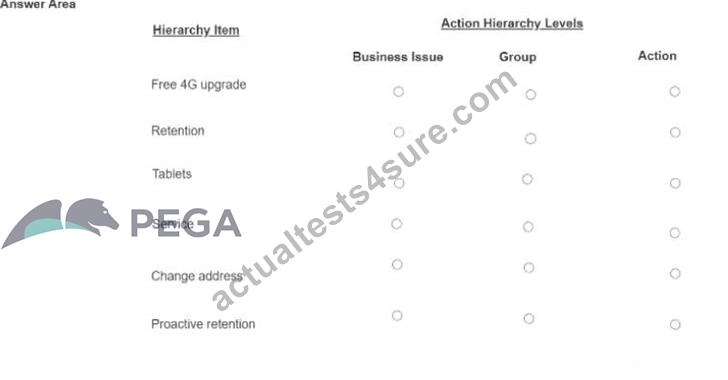
Answer:
Explanation:
Explanation:
NEW QUESTION # 45
MyCo, a telecom company, wants to introduce a new group of offers called Tablets for all customers. As a decisioning architect, which two valid actions do you create? (Choose Two)
- A. 5% discount on the price
- B. Tablet serial number
- C. Tablet operating system
- D. Netflix subscription for 12 months
Answer: A,C
NEW QUESTION # 46
Regional Bank experiences an unexpected system outage affecting online banking services across multiple locations. The bank needs to immediately inform all customers about the temporary service disruption and provide alternative banking options. The communication must reach every customer simultaneously and should not be repeated.
Which communication approach should the bank use to address this urgent customer notification requirement?
- A. Configure a promotional campaign with targeted audience segmentation rules
- B. Schedule a regular always-on outbound communication with engagement policies
- C. Create a one-time action to deliver Immediate batch communication to all customers
- D. Send individual personalized messages through the standard outbound schedules
Answer: C
NEW QUESTION # 47
U+ Bank presents various credit card offers to its customers on its website. The bank uses AI to prioritize the offers according to customer behavior. With the introduction of the Gold credit card offer, the offer click- through propensity decreased to 0.42.
What does the decrease in the propensity value most likely indicate?
- A. Similar customers do not qualify for the offer.
- B. Similar customers purchase other offers.
- C. Similar customers ignore the offer.
- D. Similar customers show interest in the offer.
Answer: C
Explanation:
The propensity is a measure of how likely a customer is to accept an offer, based on their attributes and behaviors. The propensity is calculated by using predictive analytics models that learn from historical data and feedback. A low propensity value indicates that the offer is not relevant or attractive for the customer, and that similar customers have ignored or rejected the offer in the past. Therefore, if the offer click-through propensity decreased to 0.42, it most likely indicates that similar customers ignore the offer. Verified References: Pega Decisioning Consultant | Pega Academy
NEW QUESTION # 48
U+- Bank uses Pega Customer Decision Hub'" for their one-to-one customer engagement. The bank now wants to change its offer prioritization to consider both business objectives and customer needs.
Which two factors do you configure in the Next-Best-Action Designer to implement this change? (Choose Two)
- A. Contact policies
- B. Business levers
- C. Engagement policies
- D. Context weighting
Answer: B,D
NEW QUESTION # 49
U+ Bank implemented a customer journey for its customers. The journey consists of three stages. The first stage raises awareness about available products, the second stage presents available offers, and in the last stage, customers can talk to an advisor to get a personalized quote. The bank wants to actively increase offers promotion over time.
What action does the bank need to take to achieve this business requirement?
- A. Enable constant stage upweighting for the second stage of the journey.
- B. Upweight the propensity by adding more predictors that fit the target customers and repeat this process over time.
- C. Enable increasing stage upweighting for the first stage of the journey.
- D. Enable increasing stage upweighting for the second stage of the journey.
Answer: D
Explanation:
Increasing stage upweighting is a feature that allows you to gradually increase the weight of a stage over time, making the offers in that stage more likely to be selected. This is useful for promoting offers that are time- sensitive or have a limited availability. In this case, the bank wants to actively increase offers promotion over time, so enabling increasing stage upweighting for the second stage of the journey, where the offers are presented, is the best option. Verified References: [Pega Decisioning Consultant | Pega Academy]
NEW QUESTION # 50
The U+ Bank marketing department wants to leverage the next-best-action capability of Pega Customer Decision Hub on Its website to promote new offers to each customer.
Place the events in the sequential order.
Answer:
Explanation: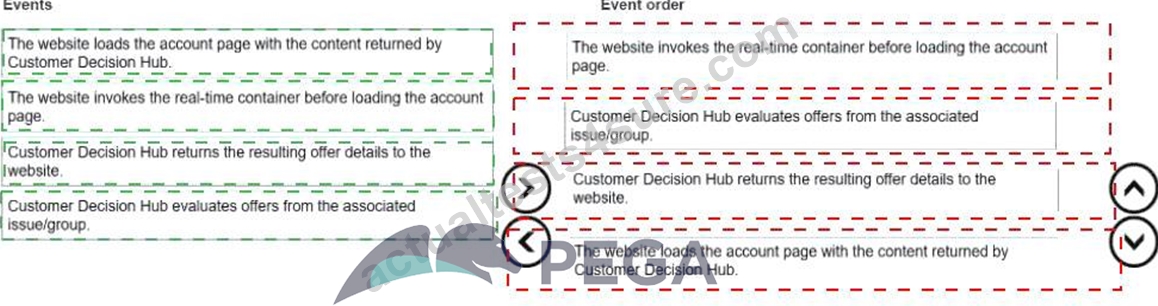
Explanation:
NEW QUESTION # 51
An outbound run identifies 150 Standard card offers, 75 on email, and 75 on the SMS channel. If the following volume constraint Is applied, how many actions are delivered by the outbound run?
- A. 75 SMSes and 25 emails
- B. 0
- C. 1
- D. 75 emails 25 SMSes
Answer: B
NEW QUESTION # 52
GlobalRetail operates in a fast-changing digital marketplace where customer preferences and competitor offers change weekly. Their marketing team struggles with lengthy approval processes that prevent quick responses to market trends, often causing them to miss critical engagement opportunities.
What does agility represent in the context of customer engagement projects?
- A. Automating all business processes through artificial Intelligence and machine learning algorithms
- B. Eliminating all testing requirements to completely accelerate software deployment cycles
- C. An organization's ability to react quickly to marketplace changes and emerging trends
- D. Outsourcing decision-making processes to external vendors for faster implementation speeds
Answer: C
NEW QUESTION # 53
The development team at U+Bank wants to create multiple test personas for their new engagement strategy quickly. A team member suggests using Pega GenAI features instead of creating a manual persona to improve efficiency and speed up the testing process.
Which advantage does Pega GenAI provide when creating personas compared to manual creation?
- A. Pega GenAI automatically builds engagement policies for every persona it creates.
- B. Pega GenAI allows describing persona traits by using natural language to speed up creation.
- C. Pega GenAI removes the need to configure channel context during persona testing.
- D. Pega GenAI creates personas that do not require validation or review after generation.
Answer: B
NEW QUESTION # 54
U+ Bank, a retail bank, has recently implemented a project in which qualified customers see mortgage offers when they log in to the web self-service portal.
Currently, only the customers who satisfy the following engagement policy conditions receive the Fifteen- year fixed-rate mortgage offer:
The bank decides to make two changes:
1. Update the suitability condition for the Fifteen-year fixed-rate mortgage offer.
2. Introduce a new offer , Twenty-year fixed-rate mortgage.
The following table shows the new engagement policy conditions for both mortgage offers:
What is the best practice to fulfill this change management requirement in the Business Operations Environment?
- A. Create a single change request in the Pega Customer Decision Hub portal.
- B. Create a single change request in the 1:1 Operations Manager portal.
- C. Create two change requests: one in the Pega Customer Decision Hub portal and the other in the 1:1 Operations Manager portal.
- D. Create two change requests in the 1:1 Operations Manager portal.
Answer: B
Explanation:
According to the best practice, a single change request should be created in the 1:1 Operations Manager portal, because both changes are related to the engagement policies and propositions that are managed in this portal. The Pega Customer Decision Hub portal is used to design and test the decision strategies, not the engagement policies and propositions. Verified References: Pega Decisioning Consultant | Pega Academy
NEW QUESTION # 55
......
PEGACPDC25V1 Question Bank: Free PDF Download Recently Updated Questions: https://www.actualtests4sure.com/PEGACPDC25V1-test-questions.html
PEGACPDC25V1 Brain Dump: A Study Guide with Tips & Tricks for passing Exam: https://drive.google.com/open?id=1O9iGnZQ5yu71behM5j3fBE7dxU6l-EbN
