

HP HPE0-J68 Real Exam Questions Test Engine Dumps Training With 285 Questions
HPE0-J68 Actual Questions Answers PDF 100% Cover Real Exam Questions
NEW QUESTION # 125
Which actions can be done within InfoSight Cross-Stack Analytics for VMware and Hyper-V? (Choose two.)
- A. View replication policies
- B. Find noisy neighbors
- C. Review backup schedules
- D. Locate inactive VMs
- E. Modify administrative privileges
Answer: B,D
NEW QUESTION # 126
Which feature allows HPE Primera, HPE Nimble, and HPE XP arrays to work with third-party management tools?
- A. Service Processor
- B. Data Protection Manager (DPM)
- C. StoreServe Management Console (SSMC)
- D. REST API
Answer: D
Explanation:
The REST API (Option A) is a critical feature that allows HPE Primera, HPE Nimble, and HPE XP arrays to work with third-party management tools. REST APIs provide a standardized interface for programmatically accessing and controlling the storage arrays. This enables integration with various management platforms, automation scripts, and orchestration tools, allowing for greater flexibility and streamlined management in diverse IT environments.
By using REST API, organizations can integrate their HPE storage systems with existing management frameworks, ensuring a cohesive and efficient infrastructure management approach.
References:
* HPE REST API for Storage
* HPE Storage Management
NEW QUESTION # 127
You are asked to review an installation plan for a new Primera storage array. The array will go into an existing environment that has been in production for over 4 years. It includes:
C7000s with Gen8 blades
8Gb Brocade switches
a 3PAR 7400
an MSA that is used as a backup target
What should you use to find appropriate installation and planning guides?
- A. NinjaSTARS
- B. SPOCK
- C. Information Library
- D. SAF Analyze and Collector
Answer: B
NEW QUESTION # 128
Which of the following are part of the SimpliVity Data Virtualization Platform architecture?
(Choose two.)
- A. User Management Layer
- B. Data Management Layer
- C. Presentation Layer
- D. Security Layer
Answer: B,C
NEW QUESTION # 129
Drag and Drop Question
A customer wants to implement a new storage network, but wants to retain the ability to connect with legacy fiber channel-based components.
Drag the appropriate component to each box on the diagram to design a new storage network.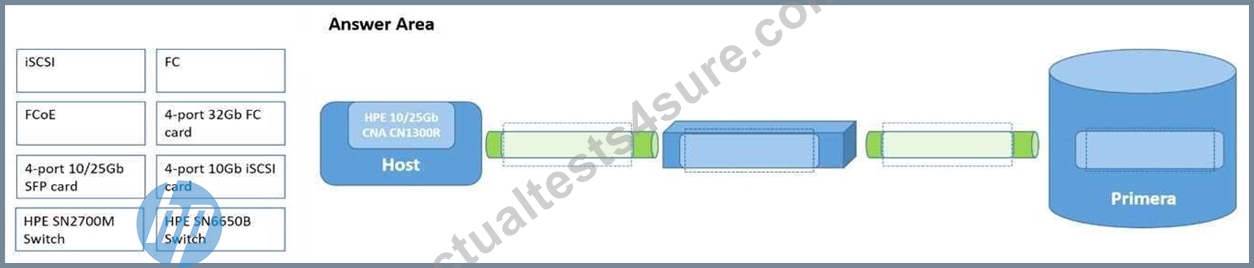
Answer:
Explanation: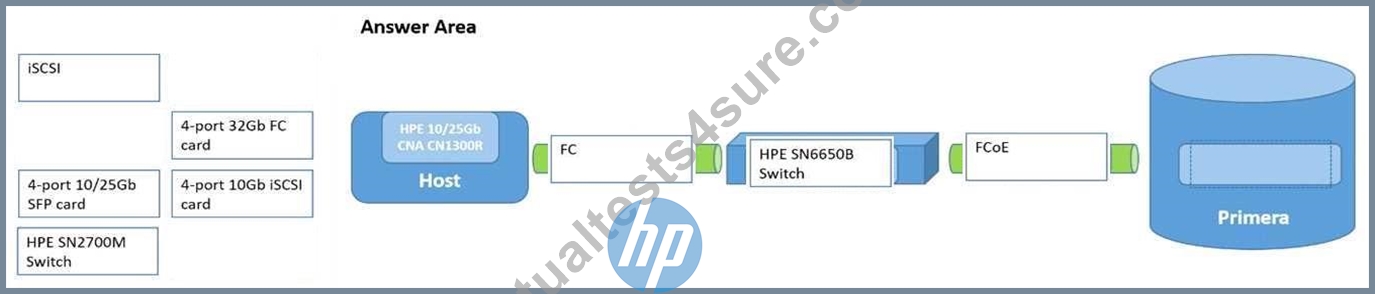
NEW QUESTION # 130
You are presenting the HPE StoreEver portfolio to a media agency.
What advantage is offered when using LTFS?
- A. WORM functionality for file, block and object storage access on tape
- B. file management capabilities will be provided with tape cartridges
- C. file and block data management within an HPE HSM solution
- D. file encryption with public and private key management
Answer: B
Explanation:
The Linear Tape File System (LTFS) provides an easy and intuitive way to manage files stored on tape cartridges. LTFS allows users to organize, browse, and access files directly from the tape as if they were on a disk. This file system presents tape as a drive letter on Windows or as a mount point on Linux, making it simpler to use tape for data archiving and management. This capability makes LTFS an attractive option for organizations that require long-term data storage with easy access.
For further details, visit:
* HPE StoreEver LTFS
NEW QUESTION # 131
Which value does a Nimble solution provide in addition to other HPE storage solutions?
- A. Flat support pricing for all hardware components
- B. All-inclusive software licensing over 5 years and additional capacity upgrades
- C. Future-proofed for newer technologies
- D. Upfront option for free controller upgrade after 3 years
Answer: C
NEW QUESTION # 132
During which event will HPE 3par Storeserv persistent port feature provide transparent and uninterrupted failover (Select two)
- A. Node maintenance or failure
- B. Loss of full-mesh cluster interconnect
- C. Loss of persistent cache
- D. Firmware upgrade
- E. B-series SAN switch upgrades
Answer: A,D
NEW QUESTION # 133
A customer is planning to replace their existing LTO-6 tape library with a new HPE StoreEver MSL2024 tape library. They want to reuse their existing LTO-6 tape cartridges for reads and writes. What is the latest tape drive technology that will provide backward compatibility?
- A. LTO5
- B. LTO7
- C. LTO6
- D. LTO8
Answer: B
NEW QUESTION # 134
While demonstrating an HPE 3PAR StoreServ 9450 array, the customer asks you to demonstrate the File Persona features.
Which objects do you need to create to demonstrate these features? (Choose two.)
- A. Host
- B. Remote copy group
- C. Virtual file server
- D. Storage container
- E. File share
Answer: C,E
NEW QUESTION # 135
A customer's growing environment has a mix of HPE 3PAR StoreServ 8200 with 10K HDD, HPE 3PAR StoreServ 9450, and HPE 3PAR StoreServ 2080D with 3 tiers of storage deployed in the same data center.
The customer needs to optimize performance by being able to move workloads to the most appropriate array as needed.
Which solution enables the customer to achieve this goal?
- A. HPE Smart SAN to provide autonomic federated management.
- B. HPE 3PAR Peer Motion with SSMC to manage storage federation.
- C. HPE OneView to automate cpg migration based on user defined policies.
- D. HPE 3PAR Remote Copy in a Synchronous Long Distance topology.
Answer: B
NEW QUESTION # 136
A customer has a SAN infrastructure with the HPE C-class blade Enclosure ,and a mix of proliant G7,gen8 and Ge9 server .They require a new storage platform ... How can you confirm the storage array will be supported in the existing environment?
- A. Document existing server and SAN information ,and consult SPOCK to ensure firmware compatibility
- B. Check recommended firmware levels in the HP SAN design reference guide to ensure firmware compatibility
- C. Design and array with the latest firmware ,and recommend that the customer engage HPE point Next to upgrade the existing hardware
- D. Design an array with older version of the firmware to ensure compatibility
Answer: A
Explanation:
To confirm that a new storage array will be supported in an existing environment that includes HPE C-class Blade Enclosures and a mix of ProLiant G7, Gen8, and Gen9 servers, the correct approach is to document the existing server and SAN information and consult the HPE SPOCK (Single Point of Connectivity Knowledge) tool. SPOCK is an HPE resource that provides detailed compatibility information for various HPE products, including firmware and software compatibility matrices. This ensures that the new storage array will work seamlessly with the existing infrastructure.
Reference:
HPE SPOCK
HPE Storage Compatibility Guides
NEW QUESTION # 137
You need to deploy a Recovery Manager Central appliance and integrate it with a customer's
3PAR system.
Which information must be collected from the customer in order to proceed with the installer?
(Choose two.)
- A. IP address of the RMC
- B. NFS path
- C. vCenter IP address or hostname
- D. HPE 3PAR used capacity
- E. StoreOnce store name
Answer: A,D
NEW QUESTION # 138
Exhibit: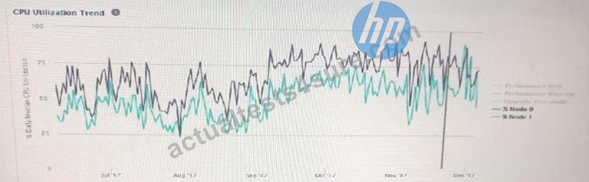
The customer has upgraded the first of their two HPE StoreServ 8200to the latest inform OS storage configuration to support oracle database volume to utilize HPE 3PAR compression .
Based on the analysis of the array .what would be your suggestion to implement the requested change?
- A. Balance the workloads between the arrays to have enough headroom for compression
- B. Consider adding another node pair for compression to work efficiently
- C. Install the catalyst agent on the oracle server to enable inline compression on the selected VV
- D. Configure the source-side the compression to offload compression to the Host
Answer: C
NEW QUESTION # 139
You are advising a customer on a new backup strategy to deploy HPE StoreOnce.
What should you recommend to ensure the best storage utilization and performance?
- A. combine management and backup Ethernet traffic
- B. consolidate activity windows for housekeeping tasks
- C. use separate backup targets for different data types
- D. size solution for a single backup device
Answer: C
Explanation:
When deploying HPE StoreOnce, it is essential to use separate backup targets for different data types to ensure optimal storage utilization and performance. Different data types may have varying deduplication ratios, backup windows, and recovery requirements. By segregating these data types into separate backup targets, the system can more efficiently manage deduplication, compression, and storage allocation, leading to better performance and reduced storage costs.
Reference:
HPE StoreOnce Best Practices
HPE Backup Solutions
NEW QUESTION # 140
You are designing a new HPE 3PAR StoreServ all-flash array for the customer.. Which ratio should you expect to have the highest efficiency?
- A. Thin provisioning ratio
- B. Compaction Ratio
- C. Read/write ratio
- D. Reclamation ratio
Answer: B
Explanation:
In an all-flash array like the HPE 3PAR StoreServ, the compaction ratio typically offers the highest efficiency. Compaction includes both deduplication and compression, which reduces the amount of physical storage needed by eliminating redundant data and compressing the data that is stored. The compaction ratio directly impacts storage efficiency, allowing for more effective utilization of the available flash storage, thereby reducing the total cost of ownership and improving performance.
References:
* HPE 3PAR StoreServ All-Flash Arrays
* HPE Storage Efficiency
NEW QUESTION # 141
Which statement regarding the deduplication process on HPE StoreOnce is a true?
- A. It can be disabled at any time
- B. It requires an extra license
- C. It is applied on a per-VTL/NAS/Catalyst Store basis
- D. It is only available for Catalyst Store
Answer: C
Explanation:
The deduplication process on HPE StoreOnce is applied on a per-VTL (Virtual Tape Library), NAS, or Catalyst Store basis. This means that deduplication settings can be configured individually for each store type, allowing for flexible data reduction strategies depending on the specific use case. Deduplication helps to significantly reduce the amount of storage required by eliminating duplicate data, making it a key feature in data protection environments.
References:
* HPE StoreOnce Deduplication
* HPE Data Reduction Technologies
NEW QUESTION # 142
Which statement is correct when comparing functionalities of the AF and HF series in the Nimble storage portfolio? (Choose Two)
- A. HF series supports storage snapshots and replication using Veeam Backup & Replication, HF and AF series support storage snapshots only
- B. >99.9999% availability is measured and guaranteed for AF and HF series arrays.
- C. Zero Copy Clones are a unique feature of All-Flash arrays within the Nimble Portfolio.
- D. HF series has a dedicated read cache and AF series does not have a dedicated reach cache.
Answer: B,D
NEW QUESTION # 143
A customer wants to make a full copy replica of a database to use for performance testing.
Which technology should they use to create the copy?
- A. snapshot
- B. clone
- C. deduplication
- D. synthetic full
Answer: B
Explanation:
When a customer needs to create a full copy replica of a database for performance testing, the best technology to use is a clone. A clone creates an exact, independent copy of a volume, which can be used separately from the original. This is particularly useful for scenarios such as testing, development, or backup, where an exact copy of the data is required without affecting the production environment.
References:
* HPE 3PAR and Primera Clone Technology
* HPE Data Protection and Replication
NEW QUESTION # 144
Which HPE system can benefit from storage class memory card?
- A. HPE Altetra 5030
- B. HPEAUetra5010H
- C. HPE Alletra 6000
- D. HPEStoreOnce
Answer: C
Explanation:
The HPE Alletra 6000 system can benefit from storage class memory (SCM) cards. SCM provides faster access times and lower latency compared to traditional flash storage, significantly improving the performance of applications that require high-speed data access. The integration of SCM into the HPE Alletra 6000 allows for better performance in latency-sensitive workloads, making it an ideal choice for demanding enterprise applications.
Reference:
HPE Alletra 6000 Overview
HPE Storage Class Memory
NEW QUESTION # 145
A solution architect is sizing the required capacity for an HPE Alletra 9000. Customer requirements include:
* 100TB base volumes
* 168 snapshots a week
* 15% daily change rate
How much capacity is needed for snapshots after one week?
- A. 700TB
- B. 1680TB
- C. 15TB
- D. 105TB
Answer: D
Explanation:
To calculate the required capacity for snapshots after one week for an HPE Alletra 9000, we start by understanding the customer's requirements:
Base volume size: 100TB
Snapshots: 168 snapshots per week
Daily change rate: 15%
The snapshot capacity requirement can be calculated by taking 15% of the base volume size per day, and multiplying it by the number of days (7 days in a week) and the number of snapshots per day.
Daily change: 15% of 100TB = 15TBTotal change over a week: 15TB * 7 days = 105TB Thus, the capacity needed for snapshots after one week is 105TB.
Reference:
HPE Alletra 9000 Overview
HPE Storage Snapshots
NEW QUESTION # 146
A customer want to implement a virtualized environment and want to provide independent storage access to individual virtual servers. Which feature need to enabled on the B-series FC switches to support this solution?
- A. RSCN
- B. ALPA
- C. FCIP
- D. NPIV
Answer: D
NEW QUESTION # 147
The customer uses an HPE Alletra 6000 system and wants to create snapshots of selected volumes automatically at a specific schedule. Which part of the web-based Ul will you recommend for this operation?
- A. Data Protection
- B. Performance Policy
- C. Hardware
- D. Data Access
Answer: A
Explanation:
In the HPE Alletra 6000 system, to create snapshots of selected volumes automatically on a specific schedule, you would use the Data Protection section of the web-based UI. This section allows you to define snapshot policies, schedule regular snapshots, and manage snapshot retention. It's specifically designed for setting up data protection strategies, including the automation of backup and recovery processes through scheduled snapshots, ensuring that critical data is always protected.
References:
* HPE Alletra 6000 Data Protection Features
* HPE Storage Management Interface
NEW QUESTION # 148
You are designing an HPE MSA iSCSI for a customer.
Which components are typically part of the solution? (Choose two.)
- A. Service Processor
- B. Switch zones
- C. SFPs
- D. Drives
- E. All-inclusive Multi-system software
Answer: C,D
Explanation:
When designing an HPE MSA iSCSI storage solution, two critical components that are typically part of the solution are Drives (Option A) and SFPs (Small Form-factor Pluggables) (Option B).
Drives: These are the storage devices (e.g., SSDs or HDDs) that provide the necessary capacity and performance for the MSA array. The choice of drives can be tailored based on the performance and capacity needs of the customer.
SFPs: These are essential for establishing iSCSI or Fibre Channel connectivity between the storage array and the network switches. They play a crucial role in ensuring that the storage solution can be integrated into the customer's existing network infrastructure.
The inclusion of these components ensures that the HPE MSA solution is fully functional and can meet the performance and connectivity requirements of the customer's environment.
Reference:
HPE MSA Storage Overview
HPE Storage Components
NEW QUESTION # 149
......
Actualtests4sure HPE0-J68 Exam Practice Test Questions: https://www.actualtests4sure.com/HPE0-J68-test-questions.html
HPE0-J68 Exam questions and answers: https://drive.google.com/open?id=1bOfv8Ts_-5WmYpp_Wjx0V-dS5NutO1OZ
