

[UPDATED 2026] Read NetSec-Analyst Study Guide Cover to Cover as Literally
100% Real & Accurate NetSec-Analyst Questions and Answers with Free and Fast Updates
NEW QUESTION # 10
Without performing a context switch, which set of operations can be performed that will affect the operation of a connected firewall on the Panorama GUI?
- A. Modification of local security rules, modification of a Layer 3 interface, modification of the firewall device hostname
- B. Modification of pre-security rules, modification of a virtual router, modification of an IKE Gateway Network Profile
- C. Modification of post NAT rules, creation of new views on the local firewall ACC tab, creation of local custom reports
- D. Restarting the local firewall, running a packet capture, accessing the firewall CLI
Answer: A
Explanation:
In Panorama, without performing a context switch, the administrator can perform local configuration tasks directly on the connected firewall. The following operations can be done:
Modification of local security rules: Security rules can be modified directly on the connected firewall from the Panorama GUI.
Modification of a Layer 3 interface: Changes to the Layer 3 interfaces on the connected firewall can be done from Panorama, without needing to switch to the firewall's local interface.
Modification of the firewall device hostname: The firewall's hostname can be changed via Panorama.
NEW QUESTION # 11
Which DNS Query action is recommended for traffic that is allowed by Security policy and matches Palo Alto Networks Content DNS Signatures?
- A. allow
- B. block
- C. alert
- D. sinkhole
Answer: D
Explanation:
To enable DNS sinkholing for domain queries using DNS security, you must activate your DNS Security subscription, create (or modify) an Anti-Spyware policy to reference the DNS Security service, configure the log severity and policy settings for each DNS signature category, and then attach the profile to a security policy rule.
https://docs.paloaltonetworks.com/pan-os/10-1/pan-os-admin/threat-prevention/dns-security/enable-dns-security
NEW QUESTION # 12
In which two Security Profiles can an action equal to the block IP feature be configured? (Choose two.)
- A. Antivirus b
- B. Anti-spyware
- C. Vulnerability Protection
- D. URL Filtering
Answer: B,C
Explanation:
The block IP feature can be configured in two Security Profiles: Vulnerability Protection and Anti-spyware.
The block IP feature allows the firewall to block traffic from a source IP address for a specified period of time after detecting a threat. This feature can help prevent further attacks from the same source and reduce the load on the firewall1. The block IP feature can be enabled in the following Security Profiles:
Vulnerability Protection: A Vulnerability Protection profile defines the actions that the firewall takes to protect against exploits and vulnerabilities in applications and protocols. You can configure a rule in the Vulnerability Protection profile to block IP connections for a specific threat or a group of threats2.
Anti-spyware: An Anti-spyware profile defines the actions that the firewall takes to protect against spyware and command-and-control (C2) traffic. You can configure a rule in the Anti-spyware profile to block IP addresses for a specific spyware or C2 signature.
References: Monitor Blocked IP Addresses, Block IP Addresses, Vulnerability Protection Profile, [Anti- Spyware Profile], Certifications - Palo Alto Networks, [Palo Alto Networks Certified Network Security Administrator (PAN-OS 10.0)] or [Palo Alto Networks Certified Network Security Administrator (PAN-OS
10.0)].
NEW QUESTION # 13
How are Application Fillers or Application Groups used in firewall policy?
- A. An Application Group is a static way of grouping applications and cannot be configured as a nested member of Application Group
- B. An Application Filter is a static way of grouping applications and can be configured as a nested member of an Application Group
- C. An Application Filter is a dynamic way to group applications and can be configured as a nested member of an Application Group
- D. An Application Group is a dynamic way of grouping applications and can be configured as a nested member of an Application Group
Answer: C
NEW QUESTION # 14
Which component is a building block in a Security policy rule?
- A. decryption profile
- B. timeout (min)
- C. application
- D. destination interface
Answer: C
Explanation:
Explanation/Reference:
https://docs.paloaltonetworks.com/pan-os/9-0/pan-os-web-interface-help/policies/policies- security
/buildingblocks-in-a-security-policy-rule.html
NEW QUESTION # 15
An administrator wants to reference the same address object in Security policies on 100 Panorama managed firewalls, across 10 device groups and five templates.
Which configuration action should the administrator take when creating the address object?
- A. Tag the address object with the Global tag.
- B. Ensure that the Shared option is cleared.
- C. Ensure that the Shared option is checked.
- D. Ensure that Disable Override is cleared.
Answer: C
Explanation:
To reference the same address object in Security policies on 100 Panorama-managed firewalls, across 10 device groups and five templates, the administrator should ensure that the Shared option is checked when creating the address object. This option allows the administrator to create a shared address object that is available to all device groups and templates on Panorama. The shared address object can then be used in multiple firewall policy rules, filters, and other functions1. This reduces the complexity and duplication of managing address objects across multiple firewalls2. Reference: Address Objects, Create a Shared Address Object, Certifications - Palo Alto Networks, Palo Alto Networks Certified Network Security Administrator (PAN-OS 10.0) or [Palo Alto Networks Certified Network Security Administrator (PAN-OS 10.0)].
NEW QUESTION # 16
What must be considered with regards to content updates deployed from Panorama?
- A. A PAN-OS upgrade resets all scheduler configurations for content updates.
- B. Panorama can only download one content update at a time for content updates of the same type.
- C. Content update schedulers need to be configured separately per device group.
- D. Panorama can only install up to five content versions of the same type for potential rollback scenarios.
Answer: B
NEW QUESTION # 17
Which plane on a Palo alto networks firewall provides configuration logging and reporting functions on a separate processor?
- A. data
- B. network processing
- C. management
- D. security processing
Answer: C
NEW QUESTION # 18
Which user mapping method could be used to discover user IDs in an environment with multiple Windows domain controllers?
- A. Windows client probing
- B. Windows session monitoring
- C. domain controller monitoring
- D. Active Directory monitoring
Answer: D
NEW QUESTION # 19
An administrator is configuring a NAT rule
At a minimum, which three forms of information are required? (Choose three.)
- A. destination zone
- B. destination address
- C. source zone
- D. name
- E. destination interface
Answer: A,B,C
NEW QUESTION # 20 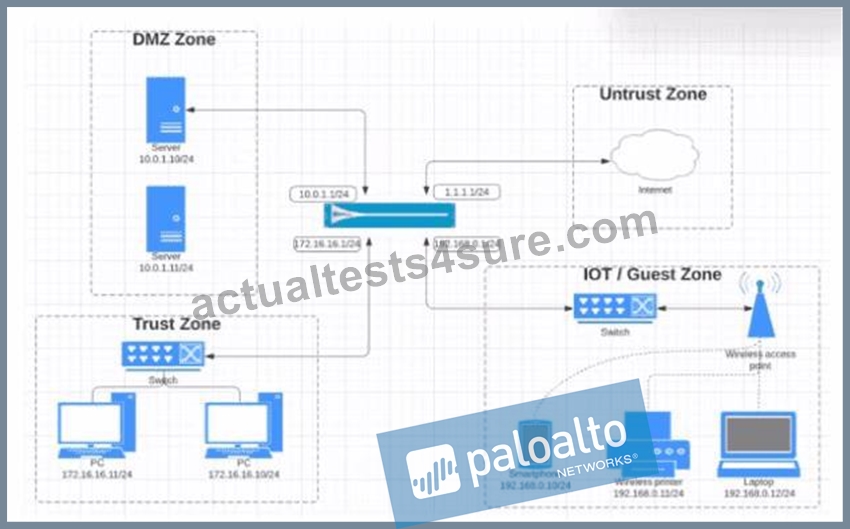
View the diagram. What is the most restrictive, yet fully functional rule, to allow general Internet and SSH traffic into both the DMZ and Untrust/lnternet zones from each of the lOT/Guest and Trust Zones?
- A.

- B.

- C.

- D.

Answer: D
NEW QUESTION # 21
Where in the PAN-OS GUI can an administrator monitor the rule usage for a specified period of time?
- A. Monitor > Packet Capture
- B. Policies > Policy Optimizer
- C. Monitor > Reports
- D. Objects > Schedules
Answer: B
Explanation:
The Policy Optimizer is a feature in the PAN-OS GUI that allows an administrator to monitor the rule usage for a specified period of time, as well as optimize the security policies based on the traffic logs and recommendations. The Policy Optimizer can help the administrator to improve the security posture, reduce the attack surface, and simplify the policy management. The Policy Optimizer can be accessed from Policies
> Policy Optimizer in the PAN-OS GUI. References: Policy Optimizer, View Policy Rule Usage, Updated Certifications for PAN-OS 10.1
NEW QUESTION # 22
Which type of Security profile is required to prevent a "Brute Force" attack on a management portal or server by monitoring the rate of connection attempts?
- A. URL Filtering Profile
- B. Vulnerability Protection Profile
- C. Antivirus Profile
- D. Anti-Spyware Profile
Answer: B
Explanation:
Comprehensive and Detailed 150 to 250 words of Explanation From Palo Alto Networks Network Security Analyst Knowledge:
The Vulnerability Protection Profile is the primary mechanism for protecting against exploit attempts and protocol-specific attacks, including Brute Force. While many associate vulnerability protection with software patches, it also includes signatures designed to detect anomalies in connection patterns.
An analyst can configure "threshold" based signatures within this profile. For example, a signature might trigger if more than 10 login attempts are made to a specific service within 60 seconds. By setting the action to block or reset, the analyst can automatically neutralize the brute force attempt before the attacker can guess a valid credential. This is a core objective for an analyst responsible for protecting high-value internal assets.
Using vulnerability protection in this manner provides a reactive defense layer that complements strong password policies and multi-factor authentication.
NEW QUESTION # 23
An advanced persistent threat (APT) group is suspected of exfiltrating data from an internal network segment to an external command- and-control (02) server over encrypted channels. The C2 communication leverages custom ports and rarely seen, but valid, SSL/TLS certificates. The security analyst has implemented SSL Forward Proxy decryption. Which specific configuration elements on the Palo Alto Networks firewall, beyond basic decryption policy, are critical to detect and prevent this sophisticated exfiltration attempt, potentially even if standard App-ID doesn't immediately identify it?
- A. Configure a 'Security Policy' with 'Any' application and 'Decrypt' action, apply a custom 'Anti-Spyware' profile with DNS sinkholing, and enable 'Vulnerability Protection' with signatures for known C2 channels.
- B. Leverage 'File Blocking' profiles to prevent specific file types, enable 'Data Filtering' profiles for sensitive data patterns, and ensure 'Threat Prevention' is applied to the decrypted traffic. Additionally, consider custom 'External Dynamic Lists' for known C2 indicators.
- C. Ensure SSL Forward Proxy decryption is fully functional for the relevant zones. Utilize WildFire' analysis for unknown files, employ 'URL Filtering' to block suspicious or new domains, and apply a 'Custom URL Category' or 'External Dynamic List' for specific C2 domains/IPs. Configure 'Custom Signatures' based on threat intelligence for C2 patterns if available. Enable 'SSH Proxy' decryption for SSH tunnels.
- D. All of the above combined, focusing on the synergy of decryption, content inspection, and threat intelligence. Specifically, full decryption allows App-ID to identify the true application, enabling granular policy enforcement and allowing Content-ID, Threat Prevention, File Blocking, and Data Filtering to inspect the domain/IP level. Custom signatures or advanced threat intelligence subscriptions are vital for detecting evasive C2.
- E. Enable 'Block Sessions with Unknown Status' in the decryption profile and ensure URL Filtering is configured to block 'Suspicious' categories.
Answer: D
Explanation:
This is a comprehensive scenario requiring a layered approach. Option E encompasses the most effective combination of features on a Palo Alto Networks firewall to combat sophisticated exfiltration over encrypted channels. Full decryption (SSL Forward Proxy) is the foundational element, as it enables all subsequent content inspection technologies (App-ID, Content-ID, Threat Prevention, File Blocking, Data Filtering) to see inside the encrypted tunnel. Without decryption, these features are severely limited. WildFire is critical for detecting zero-day malware used in exfiltration. URL Filtering and EDLs provide domain/IP reputation and blocking. Custom signatures are essential for detecting highly specific C2 patterns that might not be covered by standard databases. DNS sinkholing (from Anti-Spyware) is good, but without decryption, it might miss DNS over HTTPS. The synergy of all these features working on decrypted traffic provides the strongest defense against APTs.
NEW QUESTION # 24
Which three filter columns are available when setting up an Application Filter? (Choose three.)
- A. Category
- B. Subcategory
- C. Parent App
- D. Risk
- E. Standard Ports
Answer: A,B,D
Explanation:
https://docs.paloaltonetworks.com/pan-os/9-1/pan-os-web-interface-help/objects/objects-application-filters
NEW QUESTION # 25
Based on the screenshot what is the purpose of the included groups?
- A. They contain only the users you allow to manage the firewall.
- B. They are used to map usernames to group names.
- C. They are groups that are imported from RADIUS authentication servers.
- D. They are only groups visible based on the firewall's credentials.
Answer: B
Explanation:
Explanation/Reference:
Reference:
https://docs.paloaltonetworks.com/pan-os/9-1/pan-os-admin/user-id/map-users-to-groups.html
NEW QUESTION # 26
A Security Operations Center (SOC) team is tasked with correlating security events across 50+ Palo Alto Networks firewalls deployed globally. They need to rapidly identify anomalous behavior, generate custom reports on failed authentication attempts exceeding a threshold, and push security policy updates to specific firewall groups. Which Strata Logging Service feature set, when integrated with a centralized management system like Panorama, provides the MOST efficient and scalable solution for these requirements?
- A. Strata Logging Service's Data Lake for long-term storage and advanced analytics, leveraging its native API for custom reporting and Panorama for centralized policy deployment.
- B. Utilizing only Panorama's local log collection and reporting features, without Strata Logging Service integration.
- C. Implementing a distributed Splunk deployment without any Strata Logging Service integration.
- D. Exporting logs from each firewall directly to a CSV file and manually aggregating them for analysis.
- E. Strata Logging Service's standard log forwarding to a generic SIEM, combined with manual Panorama policy management.
Answer: A
Explanation:
Strata Logging Service's Data Lake is designed for scalable, long-term log storage and advanced analytics across numerous Palo Alto Networks devices. Its native API allows for programmatic access to log data, enabling custom report generation and integration with other security tools. Panorama provides the centralized management plane for efficient policy deployment to groups of firewalls. This combination addresses the requirements for rapid identification, custom reporting, and scalable policy management far more effectively than other options.
NEW QUESTION # 27 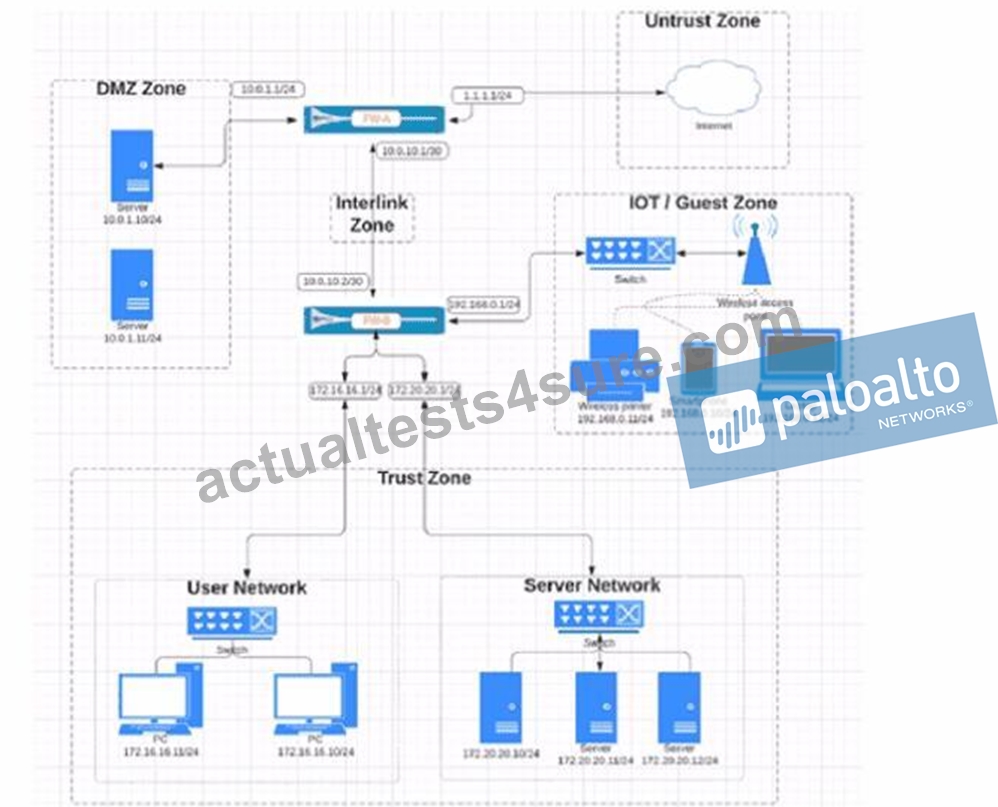
Based on the network diagram provided, which two statements apply to traffic between the User and Server networks? (Choose two.)
- A. Traffic restrictions are not possible, because the networks are in the same zone.
- B. Traffic is permitted through the default interzone "allow" rule.
- C. Traffic is permitted through the default intrazone "allow" rule.
- D. Traffic restrictions are possible by modifying intrazone rules.
Answer: C,D
Explanation:
https://knowledgebase.paloaltonetworks.com/KCSArticleDetail? id=kA10g000000ClTHCA0&lang=es
NEW QUESTION # 28
Given the screenshot what two types of route is the administrator configuring? (Choose two )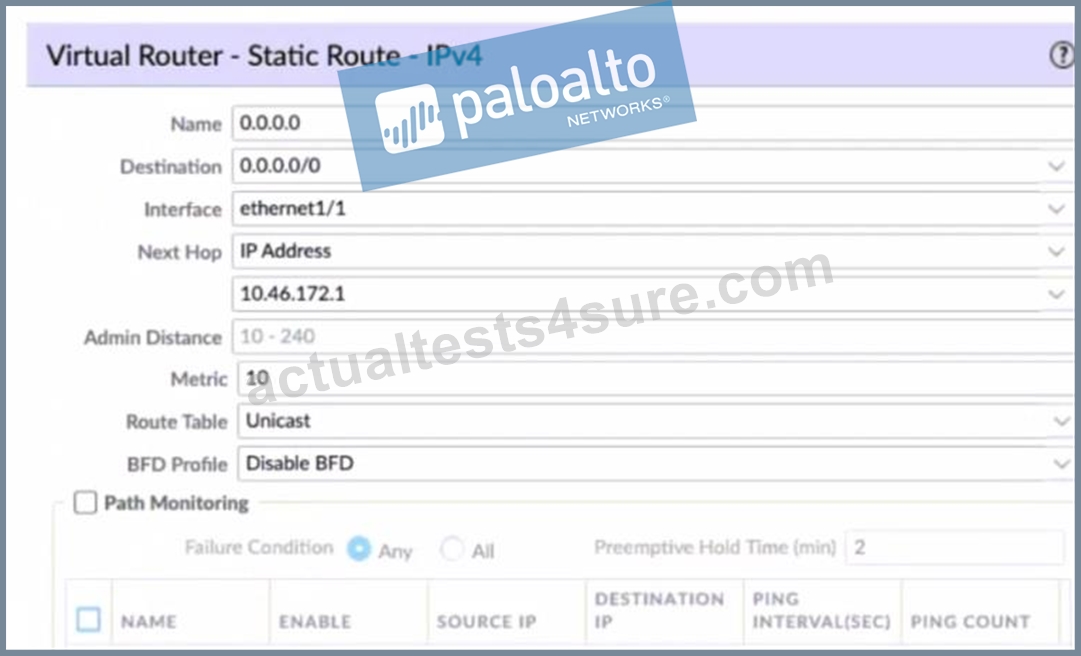
- A. default route
- B. BGP
- C. OSPF
- D. static route
Answer: A
NEW QUESTION # 29
Which two settings allow you to restrict access to the management interface? (Choose two )
- A. enabling the Content-ID filter
- B. permitted IP addresses
- C. administrative management services
- D. restricting HTTP and telnet using App-ID
Answer: A,D
NEW QUESTION # 30
......
Reliable Study Materials for NetSec-Analyst Exam Success For Sure: https://www.actualtests4sure.com/NetSec-Analyst-test-questions.html
Get Unlimited Access to NetSec-Analyst Certification Exam Cert Guide: https://drive.google.com/open?id=1JTOC3-tYDvL6os-5hU_F40r4kFJ4squb
