

Updated Nov-2025 Test Engine to Practice 350-501 Dumps & Practice Exam
Dumps Collection 350-501 Test Engine Dumps Training With 503 Questions
NEW QUESTION # 281
Refer to the exhibit.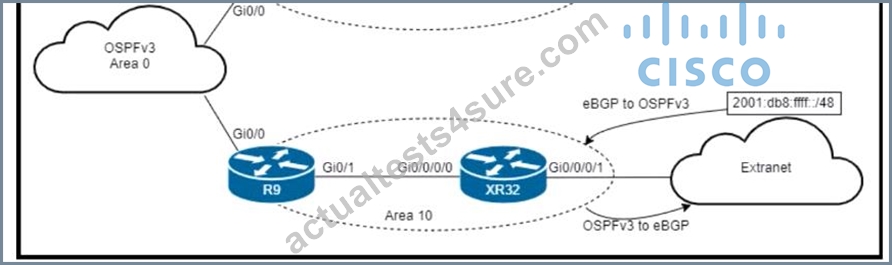
An engineer is updating this network to meet these conditions:
* Area 10 will receive inter-area routes and support mutual redistribution of external routes with the extranet.
* The ::/0 route is prohibited in Area 10.
* Area 11 will receive only the ::/0 route from the ABR.
* External route redistribution is not supported in Area 11.
* The ABR in Area 11 will advertise no interarea routes.
Which two configurations must be performed to meet the requirements? (Choose two.)
- A. Configure area 11 as nssa no-summary on R7 and as nssa on XR31.
- B. Configure area 10 as stub on R9 and XR32.
- C. Configure area 11 as nssa default-information-originate on R7 and as nssa on XR31.
- D. Configure area 11 as stub no-summary on R7 and as stub on XR31.
- E. Configure area 10 as nssa on R9 and XR32.
Answer: D,E
NEW QUESTION # 282
What should a network engineer consider before implementing segment routing?
- A. It is an MPLS-based routing technique.
- B. It is a multicast-based routing technique.
- C. It is a destination-based routing technique.
- D. It is a source-based routing technique.
Answer: B
NEW QUESTION # 283 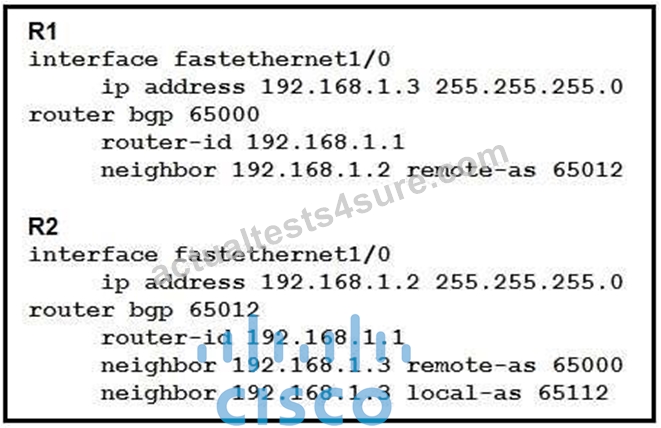
Refer to the exhibit. Assume all other configurations are correct and the network is otherwise operating normally.
Which conclusion can you draw about the neighbor relationship between routers R1 and R2?
- A. The neighbor relationship will be up only if the two devices have activated the correct neighbor relationships under the IPv4 address family.
- B. The neighbor relationship is down because R1 believes R2 is in AS 65012.
- C. The neighbor is down because the local-as value for R2 is missing in the R1 neighbor statement.
- D. The neighbor relationship is up.
Answer: B
Explanation:
Section: Networking
NEW QUESTION # 284 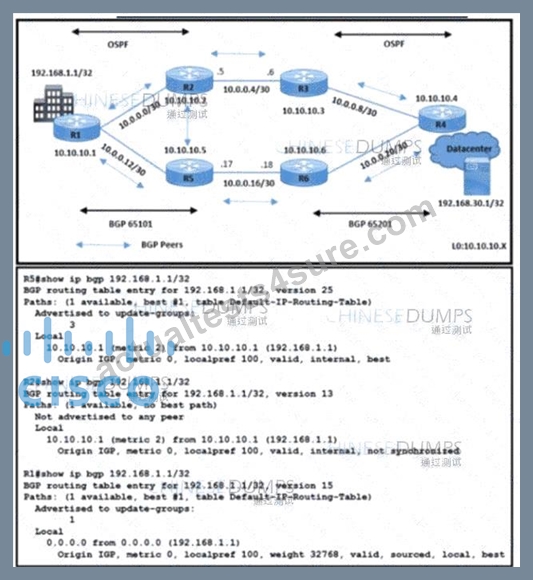
Refer to the exhibit. All BGP peering in AS 65101 and 65201 is enabled. The operations team is told that traffic destined to 192.168.1.1/32 from R4 does not use the path R3-R2-R1 as expected. An engineer debugs the issue and determines that 192.168.1.1/32 is advertised in the BGP routing table on R1. Which action resolves the issue?
- A. Enable no synchronization on R2 m AS65101.
- B. Apply redistribute ospf 10 on R1 in BGP AS 65101.
- C. Configure network 192.168.1.1 mask 255.255.255.255 in BGP AS 65101 on R2
- D. Apply route-map High-LP out for prefix 192.168.1.1/32 on R1 with R2 BGP peering.
Answer: D
Explanation:
The issue described indicates that the preferred BGP path for traffic destined to 192.168.1.1/32 is not being used. By applying a route-map with a higher Local Preference (LP) on R1 for the prefix 192.168.1.1/32, the BGP path attributes can be manipulated to prefer the path through R2. Local Preference is a BGP attribute that determines the preferred exit path out of an AS. A higher Local Preference value is preferred over a lower one. Therefore, configuring the route-map High-LP with a higher Local Preference on R1's BGP peering with R2 will influence the BGP path selection process, ensuring that traffic for 192.168.1.1/32 prefers the path R3- R2-R1 as expected.
The solution utilizes the BGP path selection process and the manipulation of BGP attributes, as taught in the Implementing and Operating Cisco Service Provider Network Core Technologies (SPCOR) course
NEW QUESTION # 285
Which service is a VNF role?
- A. Firewall
- B. Storage
- C. Compute
- D. Network
Answer: A
Explanation:
VNF stands for virtualized network function, and commonly refers to the software form of network appliances such as a router, firewall, load-balancer etc. VNFs are mostly deployed as virtual machines (VMs) on Linux KVM or VMware vSphere hypervisors.
NEW QUESTION # 286
Which additional configuration is required for NetFlow to provide traceback information?
- A. The BGP routing process must be started for any ingress or egress data to be reported when using NetFlow. Version 5.
- B. LLDP must be configured or the device will be unable to locate a NetFlow analyzer.
- C. Cisco Express Forwarding must be configured for traffic that is egressing from the router to be properly reported.
- D. A classification ACL must be configured to identify which type of traffic will be analyzed.
Answer: D
Explanation:
NEW QUESTION # 287 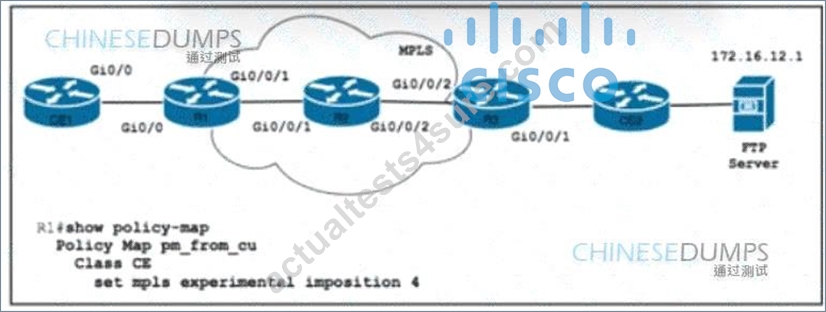
Refer to the exhibit. Router R1 is configured with class map CE with match Ip precedence critical to align with customer contract SLAs. The customer is sending all traffic from CE1 toward the FTP server with IP precedence 5 A network engineer must allow 10% of interface capacity on router R3 Which two actions must the engineer take to accomplish the task? (Choose two )
- A. Apply a policy map to R1 to reserve the remaining 10% of interface bandwidth.
- B. Implement a class map on R3 to match all packets with QoS IP precedence value 101.
- C. Implement a class map on R3 to match all packets with QoS IP precedence.
- D. Apply a policy map to R3 to reserve 10% of interface bandwidth.
- E. lmptem4Dt4M$§ map on R1 to match all packets with QoS IP precedence value 100.
Answer: A,D
Explanation:
To align with customer contract SLAs and allow 10% of interface capacity on router R3 for traffic from CE1 towards the FTP server, the network engineer must apply a policy map to R1 to reserve the remaining 10% of interface bandwidth (Option C). Additionally, applying a policy map to R3 to reserve 10% of interface bandwidth (Option D) ensures adherence to the customer's contract SLAs while utilizing the allocated bandwidth capacity. References: Implementing and Operating Cisco Service Provider Network Core Technologies (SPCOR) - Quality of Service section.
NEW QUESTION # 288
Refer to the exhibit.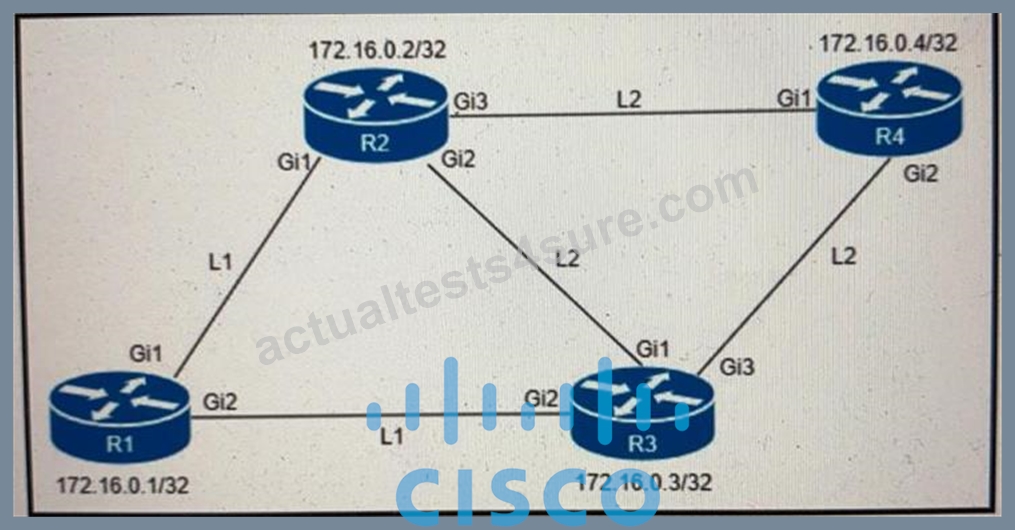
An engineer must configure router R2 as the new P router in the network. Which configuration must be applied to R2 to enable LDP-IGP Sync on its L2 IS-IS adjacencies?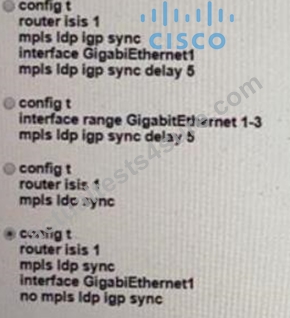
- A. Option A
- B. Option D
- C. Option B
- D. Option C
Answer: D
Explanation:
In the context of Implementing and Operating Cisco Service Provider Network Core Technologies, LDP-IGP Synchronization is configured to ensure that the IGP and LDP convergences are synchronized. Option C is correct because it shows the configuration where router ISIS 1 is being configured with MPLS LDP sync, but not on a specific interface, ensuring that LDP is operational on all interfaces where IS-IS is enabled before routes are advertised. Reference := Cisco
NEW QUESTION # 289
What is a feature of mVPN?
- A. It requires the no ip mroute-cache command to be configured on the loopback interface of each BGP peer
- B. It provides the ability to support multicast over a Layer 3 VPN
- C. It establishes multiple static MDTs for each multicast domain
- D. It requires unicast to be disabled on the multicast domain
Answer: B
NEW QUESTION # 290
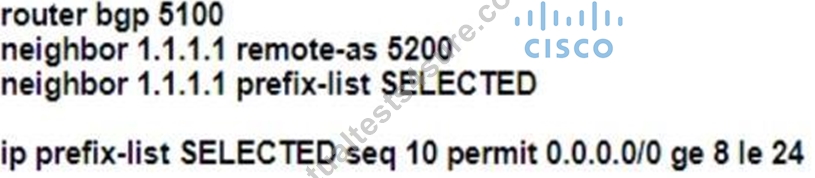
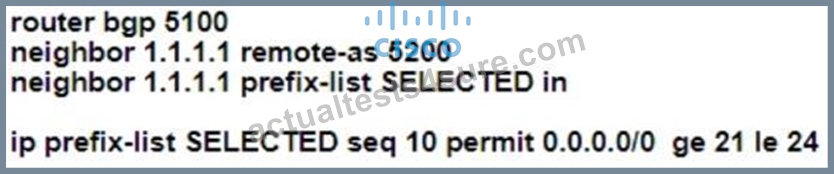
A router is advertising multiple networks to its BGP neighbor in AS 5200 with peer IP address
1.1.1.1. Which configuration must be applied so that the router permits updates only for networks with a prefix mask length less than or equal to 21?
- A.
- B.
- C.
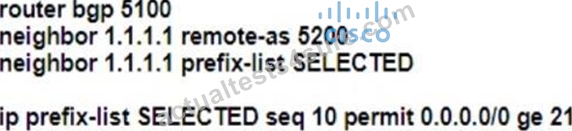
- D.
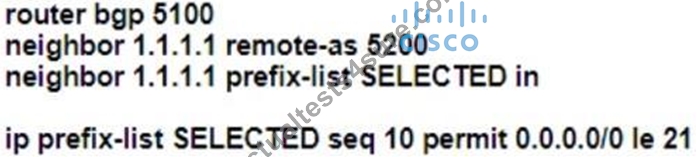
Answer: D
NEW QUESTION # 291
A network engineer must implement an ACL-based solution to mitigate availability issues on a web service that is hosted on a server at IP address 172.16.15.18/23. Access to the web server should be allowed over HTTP from RFC 1918 addresses only. The network architect has already enabled PMTUD in the network. Which ACL configuration must the engineer implement to complete the task?
- A. access-list 198 deny ip any host 172.16.15.18 fragments
access-list 198 permit 6 10.0.0.0 0.255.255.255 172.16.15.18 0.0.1.255 eq 80 access-list 198 permit 6 172.16.0.0 0.0.255.255 172.16.15.18 0.0.1.255 eq 80 access-list 198 permit 6 192.168.0.0 0.0.0.255 172.16.15.18 0.0.1.255 eq 80 access-list 198 deny ip any any - B. access-list 198 deny ip any host 172.16.15.18 ip-fragments
access-list 198 permit 18 10.10.0.0 255.255.255.0 172.16.15.18 255.255.254.0 access-list 198 permit 18 172.16.0.0 255.255.0.0 172.16.15.18 255.255.254.0 access-list 198 permit 18 192.168.0.0 255.255.255.0 172.16.15.18 255.255.254.0 access-list 198 deny tcp any any - C. access-list 199 deny ip any host 172.16.15.18 tcp-fragments
access-list 199 permit tcp 10.0.0.0 255.255.255.255 172.16.15.18 0.254.0.255 eq 80 access-list 199 permit tcp 172.16.0.0 0.0.255.255 172.16.15.18 0.0.254.255 eq 80 access-list 199 permit tcp 192.168.0.0 0.0.0.255 172.16.15.18 0.0.254.255 eq 80 access-list 199 deny ip any any - D. access-list 199 deny tcp any host 172.16.15.18 http-fragments
access-list 199 permit 16 10.10.0.0 0.255.255.255 172.16.15.18 0.0.2.253 eq 80 access-list 199 permit 16 172.16.0.0 0.0.255.255 172.16.15.18 0.0.2.253 eq 80 access-list 199 permit 16 192.168.0.0 0.0.0.255 172.16.15.18 0.0.2.253 eq 80 access-list 199 deny tcp any any
Answer: A
Explanation:
The correct ACL ensures that:
1. Fragmented packets destined for the web server are denied (deny ip any host 172.16.15.18 fragments) to avoid potential attack vectors that exploit fragmented traffic.
2. Only HTTP traffic (TCP port 80) from RFC 1918 private IP ranges (10.0.0.0/8, 172.16.0.0/12,
192.168.0.0/16) is permitted to the web server at 172.16.15.18/23. This is achieved using permit
6 (protocol 6 for TCP) with the correct source and destination masks.
3. All other traffic is denied by the final deny ip any any statement.
This configuration aligns with the requirement to allow access to the web service over HTTP only from RFC 1918 addresses while denying any other traffic, including fragmented packets.
NEW QUESTION # 292
Refer to the exhibit. All listed MPLS TE tunnels have the autoroute feature enabled. All MPLS TE tunnels are up and running. Which two statements about this configuring are true? (Choose two.)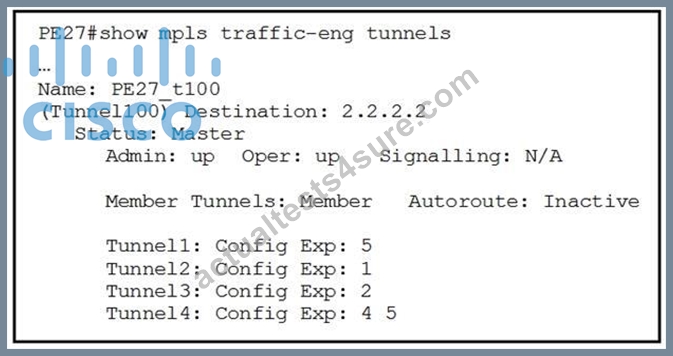
- A. Packets with unmapped EXP values are forwarded directly via MPLS TE Tunnel 100.
- B. Packets with an EXP value of 3 is assigned to MPLS TE Tunnel 1 because of an unmatched EXP.
- C. Traffic entering on PE27 marked with an EXP value of 1 is sent via MPLS TE Tunnel 2.
- D. Packets marked with an EXP value of 3 are switched via MPLS TE Tunnel 4.
- E. Packets marked with an EXP value of 5 are load balanced across MPLS TE Tunnel 1 and MPLS TE Tunnel 4.
- F. The outgoing interface towards the tail-end router is MPLS TE Tunnel 100.
- G. The EXP bundle master tunnel is not functional because of a signaling failure.
Answer: C,F
NEW QUESTION # 293
Refer to the exhibit. An engineer with an employee 10:4350:47:853 is implementing IS-IS as the new routing protocol in the network. All routers in the network operate as Level 2 routers in the same private autonomous system, and the three branches are connected via dark fibre. The engineer has already implemented IS-IS on router R1 with NET address
49.0133.532b.ca14.6915.21311.F40F.1B3a.ba10.00. Which IS-IS NET address configuration must be implemented on R3 to establish IS-IS connectivity?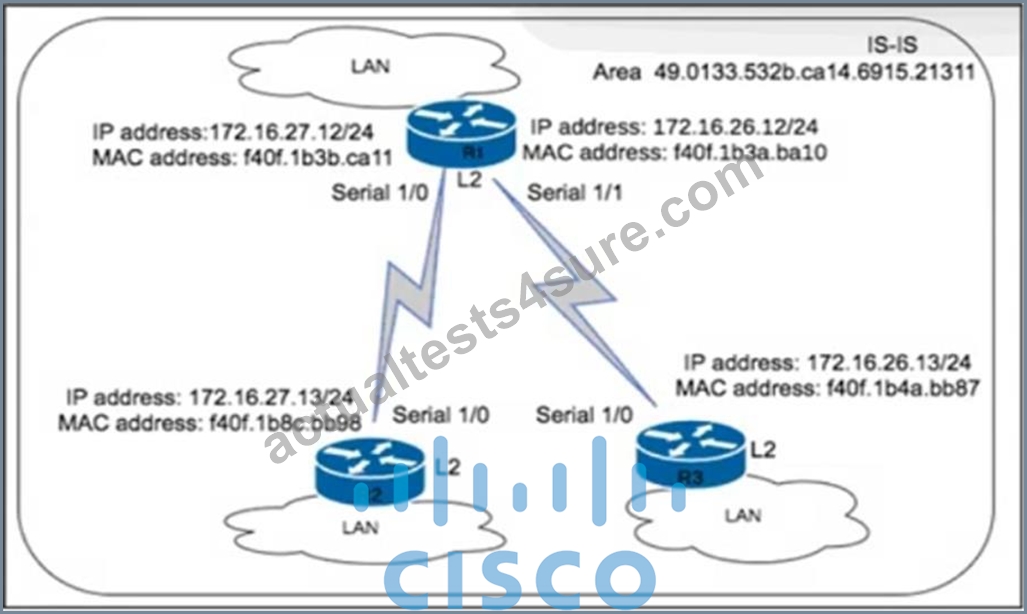
- A. 49.0135.332b.ca14.6975.28371.1721.1b3b.ca11.10
- B. 48.0133.532b.ca14.6915.21311.f40f.1626.bb98.00
- C. 49.0133.532b.ca14.6915.21311.1721.1b4a.0013.01
- D. 49.0133.532b.ca14.6915.21311.f40f.1b4a.bb87.00
Answer: B
NEW QUESTION # 294
Refer to the exhibit: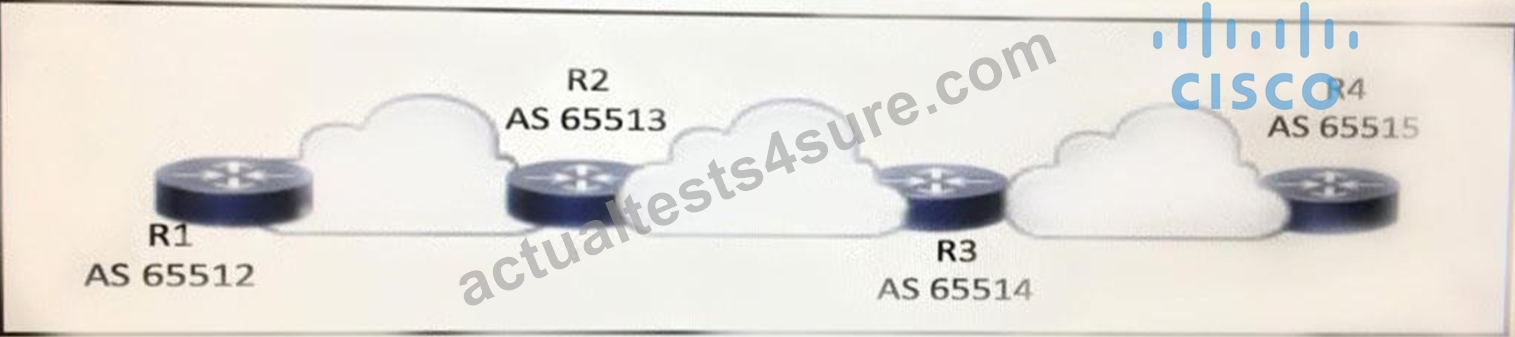
BGPsec is implemented on R1. R2. R3. and R4 BGP peering is established between neighboring autonomous systems Which statement about implementation is true?
- A. BGP updates from the iBGP peers are appended with a community of local-as
- B. BGP updates from the eBGP peers are appended with an additional AS path value that is statically set by the domain administrator
- C. BGP updates from the eBGP peers are appended with a BGPsec attribute sequence that includes a public key hash and digital signature
- D. BGP updates from the all BGP peers are appended with a community of no export
Answer: C
NEW QUESTION # 295
Refer to the exhibit.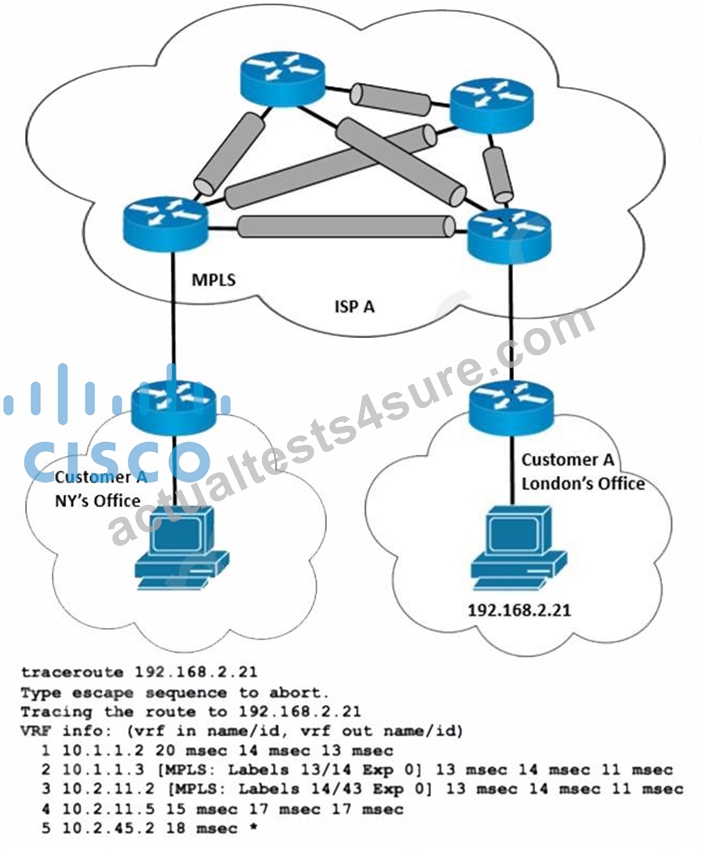
Refer to the exhibit. ISP A provides MPLS L3VPN service to customer A with BGP as the external routing protocol. Customer A has just opened a new branch office in London and requested the service provider to implement lossless service between its two offices. The LDP is enabled over the MPLS backbone and label exchange is working normally. Which action must the ISP engineering team take to enable the service?
- A. Configure IGP LDP synchronization
- B. Configure IGP and redistribute the route from BGP.
- C. Configure BGP address family VPNv4.
- D. Configure LDP and redistribute the route from EIGRP.
Answer: A
NEW QUESTION # 296
......
Cisco 350-501 certification exam is designed for professionals who want to excel in the field of service provider network technologies. 350-501 exam is an excellent way for individuals to demonstrate their skills and knowledge in implementing and operating Cisco Service Provider Network Core Technologies. Implementing and Operating Cisco Service Provider Network Core Technologies certification focuses on advanced-level skills required for implementation, configuration, and troubleshooting of service provider network infrastructure and services.
Cisco 350-501 Dumps Cover Real Exam Questions: https://www.actualtests4sure.com/350-501-test-questions.html
Real 350-501 dumps - Real Cisco dumps PDF: https://drive.google.com/open?id=1KmtgQcO-2XlsP8QxJZfiQyMKtX1PEDyh
