

VALID JN0-336 Exam Dumps For Certification Exam Preparation
JN0-336 Dumps PDF 2026 Strategy Your Preparation Efficiently
NEW QUESTION # 21
How does the SSL proxy detect if encryption is being used?
- A. It uses application identity services.
- B. It verifies the length of the packet
- C. It queries the client device.
- D. It looks at the destination port number.
Answer: D
Explanation:
The SSL proxy can detect if encryption is being used by looking at the destination port number of the packet. If the port number is 443, then the proxy can assume that the packet is being sent over an encrypted connection. If the port number is different, then the proxy can assume that the packet is not encrypted. For more information, please refer to the Juniper Networks JNCIS-SEC Study Guide.
NEW QUESTION # 22
Which two functions does Juniper ATP Cloud perform to reduce delays in the inspection of files?
(Choose two.)
- A. Juniper ATP Cloud allows end users to bypass the inspection of files.
- B. Juniper ATP Cloud performs a cache lookup on files.
- C. Juniper ATP Cloud allows the creation of allowlists.
- D. Juniper ATP Cloud uses a single antivirus software package to analyze files.
Answer: B,C
Explanation:
Juniper ATP Cloud is a cloud-based service that provides advanced threat prevention and detection for your network. It integrates with SRX Series firewalls and MX Series routers to analyze files and network traffic for signs of malicious activity.
Two functions that Juniper ATP Cloud performs to reduce delays in the inspection of files are:
Juniper ATP Cloud allows the creation of allowlists: Allowlists are lists of trusted files or file hashes that are excluded from scanning by Juniper ATP Cloud. You can create allowlists based on file name, file type, file size, file hash, or sender domain. By using allowlists, you can reduce the number of files that need to be uploaded to Juniper ATP Cloud for analysis and improve the performance and efficiency of your network.
Juniper ATP Cloud performs a cache lookup on files: Cache lookup is a process that checks if a file has been previously scanned by Juniper ATP Cloud and if there is a cached verdict for it. If there is a cached verdict, Juniper ATP Cloud returns it immediately without scanning the file again. If there is no cached verdict, Juniper ATP Cloud uploads the file for analysis. By using cache lookup, you can reduce the time and bandwidth required for scanning files by Juniper ATP Cloud.
Reference: = [Juniper Advanced Threat Prevention Cloud (ATP Cloud)], [Configuring Allowlists],
[Understanding Cache Lookup]
NEW QUESTION # 23
You are preparing a proposal for a new customer who has submitted the following requirements for a vSRX deployment:
-- globally distributed,
-- rapid provisioning,
-- scale based on demand,
-- and low CapEx.
Which solution satisfies these requirements?
- A. AWS
- B. VMWare ESXi
- C. Network Director
- D. Juniper ATP Cloud
Answer: A
Explanation:
The solution that satisfies the requirements for a vSRX deployment is AWS. AWS (Amazon Web Services) is a cloud computing platform that provides on-demand services such as infrastructure, platform, software, and database as a service. AWS is globally distributed, meaning that it has data centers in multiple regions around the world. AWS also allows rapid provisioning, meaning that you can launch vSRX instances in minutes using preconfigured Amazon Machine Images (AMIs) or custom templates. AWS also enables scaling based on demand, meaning that you can adjust the number and size of vSRX instances according to your network traffic and performance needs. AWS also has low CapEx (capital expenditure), meaning that you only pay for what you use and do not need to invest in hardware or maintenance costs.
Reference: = vSRX Deployment Guide for AWS, Understand vSRX Virtual Firewall with AWS, What Is Amazon Web Services?
NEW QUESTION # 24
Exhibit
Referring to the exhibit which statement is true?
- A. SSL proxy functions will ignore the session.
- B. SSL proxy leverages post-match results.
- C. SSL proxy must wait for return traffic for the final match to occur.
- D. SSL proxy leverages pre-match result
Answer: C
NEW QUESTION # 25
When a security policy is deleted, which statement is correct about the default behavior of active sessions allowed by that policy?
- A. The active sessions allowed by the policy will continue
- B. The active sessions allowed by the policy will be marked as a legacy flow and will continue to be forwarded.
- C. The active sessions allowed by the policy will be reevaluated by the cached
- D. The active sessions allowed by the policy will be dropped.
Answer: B
Explanation:
When a security policy is deleted, the existing sessions that were previously allowed by that policy are not immediately dropped; instead, they are typically treated as legacy flows. This means they are allowed to continue until they naturally end or until the session timeout is reached. This behavior ensures that deleting a policy does not abruptly disrupt ongoing traffic flows that were previously authorized by that policy. This approach helps in avoiding unintended service disruptions, especially in production environments where active connections may be critical to operations.
NEW QUESTION # 26
You want to control when cluster failovers occur.
In this scenario, which two specific parameters would you configure on an SRX Series device? (Choose two.)
- A. heartbeat-cos
- B. heartbeat-interval
- C. heartbeat-address
- D. heartbeat-threshold
Answer: B,D
Explanation:
To control when cluster failovers occur, you need to configure two specific parameters on an SRX Series device: heartbeat-interval and heartbeat-threshold. These parameters determine how often the nodes in a cluster exchange heartbeat messages and how many consecutive heartbeats can be missed before a failover is triggered. The heartbeat-interval specifies the time interval in seconds between each heartbeat message. The default value is 1 second and the range is from 0.1 to 10 seconds. The heartbeat- threshold specifies the number of consecutive heartbeats that must be missed before a failover occurs.
The default value is 3 and the range is from 2 to 255.
Reference: = Configuring Chassis Clustering on SRX Series Devices, Chassis Cluster Redundancy Group Failover
NEW QUESTION # 27
Which two statements are correct about the cSRX? (Choose two.)
- A. The cSRX supports BGP, OSPF. and IS-IS routing services.
- B. The cSRX has three default zones: trust, untrust, and management
- C. The cSRX supports firewall, NAT, IPS, and UTM services.
- D. The cSRX only supports Layer 2 "bump-in-the-wire" deployments.
Answer: B,C
Explanation:
The two statements that are correct about the cSRX are that it supports firewall, NAT, IPS, and UTM services, and that it has three default zones: trust, untrust, and management. The cSRX is a software- defined security solution that provides comprehensive network security capabilities and is designed for virtualized environments. It supports firewall, NAT, IPS, and UTM services to protect against threats, as well as BGP, OSPF, and IS-IS routing services for routing functionality. Additionally, the cSRX has three default zones: trust, untrust, and management. The trust zone is used to define traffic that is allowed to enter the network, the untrust zone is used to define traffic that should be blocked from entering the network, and the management zone is used to manage the device itself. The cSRX does not support Layer 2 "bump-in-the-wire" deployments.
NEW QUESTION # 28
You enable chassis clustering on two devices and assign a cluster ID and a node ID to each device.
In this scenario, what is the correct order for rebooting the devices?
- A. Reboot the secondary device, then the primary device.
- B. Reboot only the primary device since the secondary will assign itself the correct cluster and node ID.
- C. Reboot only the secondary device since the primary will assign itself the correct cluster and node ID.
- D. Reboot the primary device, then the secondary device.
Answer: A
Explanation:
When chassis clustering is enabled and IDs are assigned, it is typically recommended to first reboot the secondary device. This allows the secondary device to fully integrate and recognize its role and settings within the cluster without affecting the ongoing traffic that the primary device might be handling.
Once the secondary device has successfully rebooted and is operational within the cluster, the primary device can then be rebooted. This ensures that the primary device's reboot does not cause any network downtime, as the secondary device, now fully operational, can take over the traffic and roles as needed.
NEW QUESTION # 29
Click the Exhibit button.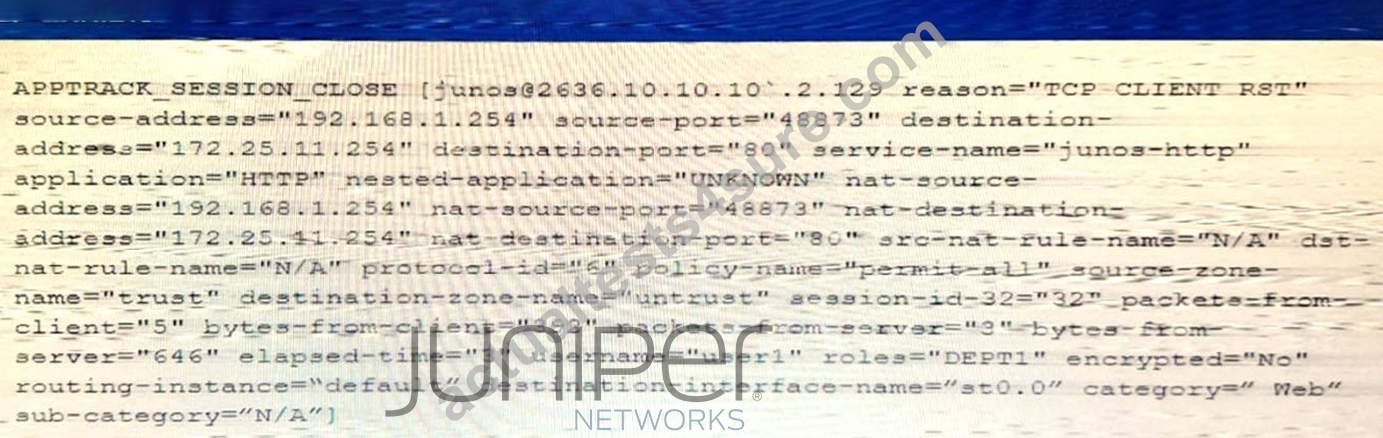
Which two statements about the log output shown in the exhibit are correct? (Choose two)
- A. Traffic destined to the HTTP server is placed in an IPsec tunnel
- B. AppTrack is enabled on the trast zone.
- C. AppTrack is enabled on the untrust zone.
- D. Source NAT is performed
Answer: B,C
NEW QUESTION # 30
Click the Exhibit button.
Which two statements describe the output shown in the exhibit? (Choose two.)
- A. Node 1 is controlling traffic for redundancy group 1.
- B. Redundancy group 1 experienced an operational failure.
- C. Redundancy group 1 was administratively failed over.
- D. Node 0 is controlling traffic for redundancy group 1.
Answer: A,D
Explanation:
The output indicates that node1 has a priority of 200 and is marked as "Primary," which means it is currently the active node controlling traffic for redundancy group 1. The "Primary" status designates that this node is handling the traffic for the specified redundancy group.
According to the exhibit, node0 is listed with a priority of 0 and is marked as "Secondary." This status indicates that node0 is currently not controlling traffic for redundancy group 1, serving instead in a standby role ready to take over should node1 fail or become unavailable.
NEW QUESTION # 31
Click the Exhibit button.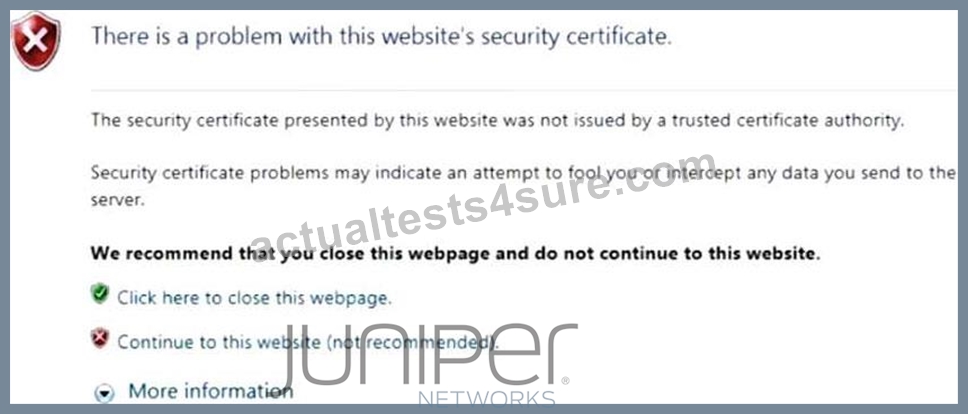
You have implemented SSL client protection proxy. Employees are receiving the error shown in the exhibit.
How do you solve this problem?
- A. Install a new SRX Series device to act as the client proxy
- B. Import the existing certificate to each client device.
- C. Load a known good, but expired. CA certificate onto the SRX Series device.
- D. Reboot the SRX Series device.
Answer: B
Explanation:
SSL client protection proxy is a feature that allows you to decrypt and inspect the SSL traffic from clients to servers. To do this, you need to install a certificate authority (CA) certificate on the SRX Series device and import the same certificate to each client device. This way, the SRX Series device can act as a proxy between the client and the server and perform security checks on the decrypted traffic. If the client device does not have the certificate installed, it will receive an error message like the one shown in the exhibit. Reference: = JNCIS-SEC Certification, Open Learning - Security, Specialist (JNCIS-SEC), SSL Proxy Configuration
NEW QUESTION # 32
Which two statements are true about Juniper ATP Cloud? (Choose two.)
- A. Dynamic analysis is not always necessary to determine if a file contains malware.
- B. If the cache lookup determines that a file contains malware, static analysis is not performed to verify the results.
- C. If the cache lookup determines that a file contains malware, performed to verify the results.
- D. Dynamic analysis is always performed to determine if a file contains malware.
Answer: A,B
Explanation:
Dynamic analysis is not always necessary to determine if a file contains malware, as the ATP Cloud uses a cache lookup to quickly identify known malicious files. If the cache lookup determines that a file contains malware, static analysis is not performed to verify the results. This information can be found on the Juniper website here: https://www.juniper.net/documentation/en_US/release- independent/security/jnpr-security-srx-series/inform
NEW QUESTION # 33
You are asked to ensure that if the session table on your SRX Series device gets close to exhausting its resources, that you enforce a more aggress.ve age-out of existing flows.
In this scenario, which two statements are correct? (Choose two.)
- A. The high-watermark configuration specifies the percentage of how much of the session table can be allocated before applying a more aggressive age-out timer
- B. The early-ageout configuration specifies the timeout value, in seconds, that will be applied once the low-watermark value is met.
- C. The high-watermark configuration specifies the percentage of how much of the session table is left before disabling a more aggressive age- out timer.
- D. The early-ageout configuration specifies the timeout value, in seconds, that will be applied once the high-watermark value is met.
Answer: A,D
Explanation:
The early-ageout configuration specifies the timeout value, in seconds, that will be applied once the high- watermark value is met. The high-watermark configuration specifies the percentage of how much of the session table can be allocated before applying a more aggressive age-out timer. This ensures that the session table does not become full and cause traffic issues, and also ensures that existing flows are aged out quickly when the table begins to get close to being full.
NEW QUESTION # 34
Which two statements are correct about App Track? (Choose two.)
- A. App Track collects traffic flow information including byte, packet, and duration statistics.
- B. App Track can only be configured in the main logical system on an SRX Series device.
- C. App Track can be configured for any defined logical system on an SRX Series device.
- D. App Track identifies and blocks traffic flows that might be malicious regardless of the ports being used.
Answer: A,C
Explanation:
AppTrack is a feature that allows you to monitor and analyze the application traffic on your SRX Series device. It can be configured for any defined logical system, which is a virtual router or switch within a physical device. AppTrack collects statistics such as bytes, packets, and duration for each application flow and displays them in reports or logs. AppTrack does not identify or block malicious traffic, that is the function of AppSecure or IDP/IPS. Reference: = JNCIS-SEC Certification, Open Learning - Security, Specialist (JNCIS-SEC), Application Security Theory
NEW QUESTION # 35
Your company is using the Juniper ATP Cloud free model. The current inspection profile is set at 10 MB You are asked to configure ATP Cloud so that executable files up to 30 MB can be scanned while at the same time minimizing the change in scan time for other file types.
Which configuration should you use in this scenario?
- A. Use the CLI to create a custom profile and increase the scan limit.
- B. Use the ATP Cloud Ul to change the default profile to increase the scan limit for all files to 30 MB.
- C. Use the ATP Cloud Ul to update a custom profile and increase the scan limit for executable files to 30 MB.
- D. Use the CLI to change the default profile to increase the scan limit for all files to 30 MB.
Answer: C
Explanation:
In this scenario, you should use the ATP Cloud Ul to create a custom profile and update the scan limit for executable files to 30 MB. This will ensure that executable files up to 30 MB can be scanned, while at the same time minimizing the change in scan time for other file types. To do this, log in to the ATP Cloud Ul and go to the Profiles tab. Click the Create button to create a new profile, and then adjust the scan limits for executable files to 30 MB. Once you have saved the custom profile, you can apply it to the desired systems and the new scan limit will be in effect.
NEW QUESTION # 36
Which statement regarding Juniper Identity Management Service (JIMS) domain PC probes is true?
- A. JIMS domain PC probes are initiated by an SRX Series device to verify authentication table information.
- B. JIMS domain PC probes analyze domain controller security event logs at60-mmute intervals by default.
- C. JIMS domain PC probes are triggered if no username to IP address mapping is found in the domain security event log.
- D. JIMS domain PC probes are triggered to map usernames to group membership information.
Answer: C
Explanation:
Juniper Identity Management Service (JIMS) domain PC probes are used to map usernames to IP addresses in the domain security event log. This allows for the SRX Series device to verify authentication table information, such as group membership. The probes are triggered whenever a username to IP address mapping is not found in the domain security event log. By default, the probes are executed at 60-minute intervals.
NEW QUESTION # 37
Which two statements about SRX chassis clustering are correct? (Choose two.)
- A. SRX chassis clustering supports active/passive and active/active for the data plane.
- B. SRX chassis clustering supports active/passive for the control plane.
- C. SRX chassis clustering only supports active/passive for the data plane.
- D. SRX chassis clustering supports active/active for the control plane.
Answer: A,B
Explanation:
SRX chassis clustering allows for both active/passive and active/active configurations for the data plane.
In an active/passive setup, one node is active (handling traffic) while the other remains passive (idle and waiting to take over in case of failure). In an active/active setup, both nodes can handle traffic simultaneously, distributing different traffic flows or services between them for load balancing and redundancy.
For the control plane, SRX chassis clustering typically operates in an active/passive mode. This means one node actively handles the control plane responsibilities, such as managing routing tables and maintaining sessions, while the other stands by ready to take over these tasks if the active node fails.
NEW QUESTION # 38
You have deployed an SRX300 Series device and determined that files have stopped being scanned.
In this scenario, what is a reason for this problem?
- A. You have exceeded the maximum files submission for your SRX platform size.
- B. The file is too small to have a virus.
- C. The software license is a free model and only scans executable type files.
- D. The infected host communicated with a command-and-control server, but it did not download malware.
Answer: A
Explanation:
You have exceeded the maximum files submission for your SRX platform size: This statement is correct because file scanning on SRX300 Series device has a limit on the number of files that can be submitted per minute based on the platform size3. For example, SRX320 has a limit of 10 files per minute3.
NEW QUESTION # 39
What information does encrypted traffic insights (ETI) use to notify SRX Series devices about known malware sites?
- A. dynamic address groups
- B. certificates
- C. MAC addresses
- D. domain names
Answer: D
Explanation:
Encrypted traffic insights (ETI) uses domain names to notify SRX Series devices about known malware sites. ETI is a feature of the SRX Series firewall that can detect and block malware that is hidden in encrypted traffic. It works by analyzing the domain names of the websites that the encrypted traffic is attempting to access. If the domain name matches a known malware site, ETIwill send an alert to the SRX Series device, which can then take appropriate action to block the traffic. ETI is a useful tool for protecting against threats that attempt to evade detection by hiding in encrypted traffic.
NEW QUESTION # 40
Which two statements are correct about chassis clustering? (Choose two.)
- A. The cluster ID is used to identify each device in the chassis cluster.
- B. A system reboot is required to activate changes to the cluster.
- C. The node ID value ranges from 1 to 255.
- D. The node ID is used to identify each device in the chassis cluster.
Answer: B,D
Explanation:
In chassis clustering, the node ID is indeed used to uniquely identify each device within the cluster. This allows for individual addressing and management of devices within the cluster configuration, which is crucial for operations and maintenance.
Typically, activating changes that involve chassis clustering configuration, such as setting or changing the node ID or forming a new cluster, requires a reboot of the devices. This ensures that all configuration changes are properly applied and that the devices can synchronize their states as part of the cluster.
NEW QUESTION # 41
......
Latest Verified & Correct JN0-336 Questions: https://www.actualtests4sure.com/JN0-336-test-questions.html
100% Pass Guaranteed Download JNCIS-SEC Exam PDF Q&A: https://drive.google.com/open?id=1WwnESY-rqjaVMjoOzFnLPK5ExXoLgoJK
