

300-420 Dumps 2021 - New Cisco 300-420 Exam Questions
Free 300-420 braindumps download (300-420 exam dumps Free Updated)
NEW QUESTION 12
An organization is designing a detailed QoS plan that limits bandwidth to specific rates. Which two parameters are supported be the traffic policing feature? (Choose two.)
- A. conforming
- B. violating
- C. bursting
- D. marking
- E. shaping
Answer: D,E
NEW QUESTION 13
A company is using OSPF between its HQ location and a branch office. HQ is assigned area 0 and the branch office is assigned area 1. The company purchases a second branch office, but due to circuit delays to HQ, it decides to connect the new branch office to the creating branch office as a temporary measure. The new branch office is assigned area 2. Which OSPF configuration enables all three locations to exchange routes?
- A. A sham link must be configured between the new branch office and HQ
- B. A virtual link must be configured between the new branch office and HQ
- C. The existing branch office must be configured as a stub area
- D. The new branch office must be configured as a stub area
Answer: B
NEW QUESTION 14
Refer to the exhibit. An architect must design a solution to connect the network behind R3 with the EIGRP network. Which mechanism should be included to avoid routing loops?
- A. split-horizon
- B. route tags
- C. summarization
- D. down bit
Answer: B
NEW QUESTION 15
When a network is designed using IS-IS protocol, which two circuit types are supported? (Choose two.)
- A. point-to-multipoint
- B. nonbroadcast multiaccess
- C. multiaccess
- D. nonbroadcast
- E. point-to-point
Answer: C,E
Explanation:
Section: Advanced Addressing and Routing Solutions
NEW QUESTION 16
Which three feature sets are used in Stackwise technology? (Choose three.)
- A. WAN Services
- B. IP Services
- C. IP Base
- D. ARP Base
- E. LAN Agent
- F. LAN Base
Answer: B,C,F
NEW QUESTION 17
An engineer is working for a large cable TV provider that requires multiple sources streaming video on different channels using multicast with no rendezvous point.
Which multicast protocol meets these requirements?
- A. PIM-SSM
- B. BIDIR-PIM
- C. PIM-SM
- D. any-source multicast
Answer: A
NEW QUESTION 18
An infrastructure team is concerned about the shared memory utilization of a device, and for this reason, they need to monitor the device state. Which solution limits impact on the device and provides the required data?
- A. on-change subscription
- B. periodic subscription
- C. static telemetry
- D. IPFIX
Answer: D
Explanation:
Section: Automation
Explanation
Explanation/Reference:
NEW QUESTION 19
A client is moving to Model-Driven Telemetry and requires periodic updates. What must the network architect consider with this design?
- A. Empty data subscriptions do not generate empty update notifications.
- B. Updates that contain changes within the data are sent only when changes occur.
- C. The primary push update is sent immediately and cannot be delayed.
- D. Periodic updates include a full copy of the data that is subscribed to.
Answer: B
NEW QUESTION 20
The implementations group has been using the test bed to do a 'proof-of-concept' that requires both Client 1 and Client 2 to access the WEB Server at 209.65.200.241. After several changes to the network addressing, routing scheme, DHCP services, NTP services, layer 2 connectivity, FHRP services, and device security, a trouble ticket has been opened indicating that Client 1 cannot ping the 209.65.200.241 address.
Use the supported commands to isolated the cause of this fault and answer the following questions.
The fault condition is related to which technology?
- A. IPv4 layer 3 security
- B. IPv4 OSPF Routing
- C. IPv4 OSPF Redistribution
- D. IPv6 OSPF Routing
- E. NTP
- F. IP NAT
- G. BGP
Answer: B
Explanation:
On R1, for IPV4 authentication of OSPF the command is missing and required to configure------ ip ospf authentication message-digest
NEW QUESTION 21
Which two BGP features will result in successful route exchanges between eBGP neighbors sharing the same AS number? (Choose two.)
- A. client-to-client reflection
- B. advertise-best-external
- C. allow-as-in
- D. bestpath as-path ignore
- E. as-override
Answer: C,E
Explanation:
Explanation
NEW QUESTION 22
A customer requests a VPN solution to connect multiple sites with the company headquarters. All the sites use the same IP subnet. The engineer plans to use VPLS. Which solutions must the engineer include in the design?
- A. address translation to hide overlapping subnets
- B. route exchange with the service provider
- C. different VLANs on each site
- D. 802.1Q connectivity on the LAN side of the CE
Answer: D
NEW QUESTION 23
Refer to the exhibit. An engineer is designing an OSPF network for a client. Requirements dictate that the routers in Area 1 should receive all routes belonging to the network, including EIGRP, except the ones originated in the RIP domain. Which action should the engineer take?
- A. Make the area 1 routers part of area 0.
- B. Make area 1 a stub.
- C. Make area 1 a NSSA.
- D. Make area 1 a standard OSPF area.
Answer: C
Explanation: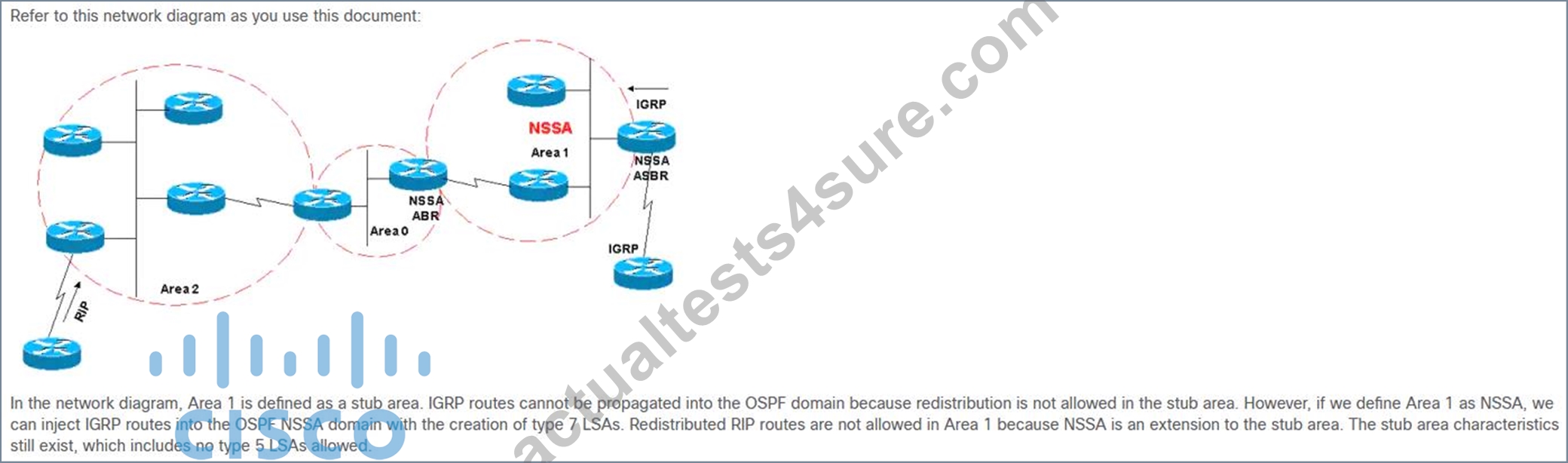
NEW QUESTION 24
A company is using OSPF between its HQ location and a branch office. HQ is assigned area 0 and the branch office is assigned area 1. The company purchases a second branch office, but due to circuit delays to HQ, it decides to connect the new branch office to the existing branch office as a temporary measure. The new branch office is assigned to area 2. Which OSPF configuration enables all three locations to exchange routes?
- A. A sham link must be configured between the new branch office and HQ
- B. A virtual link must be configured between the new branch office and HQ
- C. The existing branch office must be configured as a stub area
- D. The new branch office must be configured as a stub area
Answer: B
Explanation:
Section: Advanced Addressing and Routing Solutions
NEW QUESTION 25
Drag and drop the model driven telemetry characteristics from the left onto the mode they belong to on the right.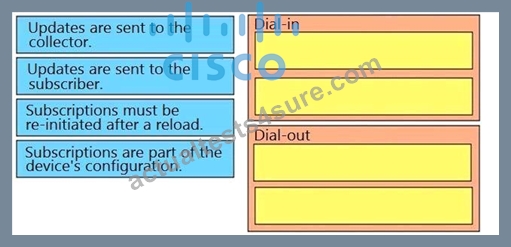
Answer:
Explanation: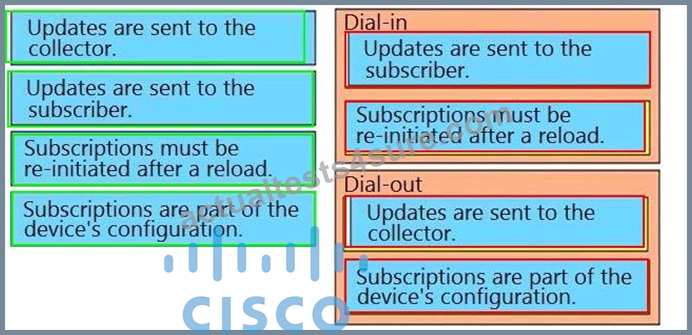
NEW QUESTION 26
An engineer must design a multicast network for a financial application. Most of the multicast sources also receive multicast traffic (many-to-many deployment model). To better scale routing tables, the design must not use source trees. Which multicast protocol satisfies these requirements?
- A. PIM-SSM
- B. PIM-SM
- C. BIDIR-PIM
- D. MSDP
Answer: B
NEW QUESTION 27
Which two steps can be taken to improve convergence in an OSPF network? (Choose two.)
- A. Use Bidirectional Forwarding Detection
- B. Span the same IP network across multiple areas.
- C. Tune OSPF parameters
- D. Make all non-backbone areas stub areas
- E. Merge all the areas into one backbone area
Answer: A,C
NEW QUESTION 28
A network engineer is redesigning a company's QoS solution. The company is currently using IP Precedence, but the engineer plans to move to DiffServ. It is important that the new solution provide backward compatibility with the current solution. Which technology should the design include?
- A. default per hop behavior
- B. expedited forwarding
- C. class selector code points
- D. assured forwarding
Answer: C
Explanation:
Section: Network Services
NEW QUESTION 29 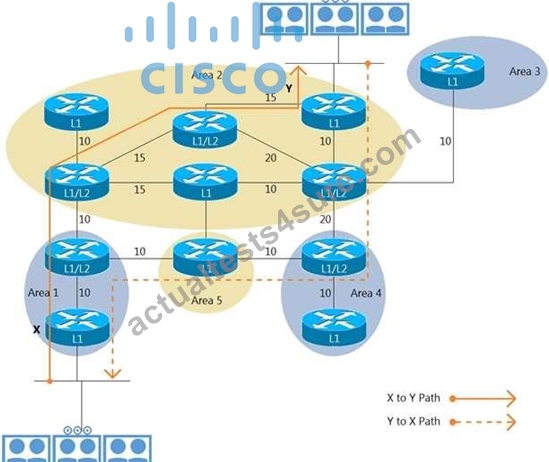
Refer to the exhibit. Customers report low video quality and delays when having point-to-point telepresence video calls between the two locations. An architect must optimize a design so that traffic follows the same path for egress and ingress traffic flows. Which technique optimizes the design?
- A. Configure route leaking on the router in area 1.
- B. Configure the high metric on the router in area 4.
- C. Configure route filter on the router in area 4.
- D. Configure route leaking on the router in area 2.
Answer: B
Explanation:
Section: WAN for Enterprise Networks
NEW QUESTION 30
See the solution below
Explanation/Reference:
There are two ways to configure interVLAN routing in this case:
+ Use RouterC as a "router on a stick" and SwitchC as a pure Layer2 switch. Trunking must be established between RouterC and SwitchC.
+ Only use SwitchC for interVLAN routing without using RouterC, SwitchC should be configured as a Layer 3 switch (which supports ip routing function as a router). No trunking requires.
The question clearly states "No trunking has been configured on RouterC" so RouterC does not contribute to interVLAN routing of hosts H1 & H2 -> SwitchC must be configured as a Layer 3 switch with SVIs for interVLAN routing.
We should check the default gateways on H1 & H2. Click on H1 and H2 and type the "ipconfig" command to get their default gateways.
Answer:
Explanation:
\>ipconfig
We will get the default gateways as follows:
Host1:
+ Default gateway: 190.200.250.33
Host2:
+ Default gateway: 190.200.250.65
Now we have enough information to configure SwitchC (notice the EIGRP AS in this case is 650) Note: VLAN2 and VLAN3 were created and gi0/10, gi0/11 interfaces were configured as access ports so we don't need to configure them in this sim.
SwitchC# configure terminal
SwitchC(config)# int gi0/1
SwitchC(config-if)#no switchport -> without using this command, the simulator does not let you assign IP address on Gi0/1 interface.
SwitchC(config-if)# ip address 10.10.10.2 255.255.255.0 ->RouterC has used IP 10.10.10.1 so this is the lowest usable IP address.
SwitchC(config-if)# no shutdown
SwitchC(config-if)# exit
SwitchC(config)# int vlan 2
SwitchC(config-if)# ip address 190.200.250.33 255.255.255.224
SwitchC(config-if)# no shutdown
SwitchC(config-if)# int vlan 3
SwitchC(config-if)# ip address 190.200.250.65 255.255.255.224
SwitchC(config-if)# no shutdown
SwitchC(config-if)#exit
SwitchC(config)# ip routing (Notice: MLS will not work without this command) SwitchC(config)# router eigrp 65010 SwitchC(config-router)# network 10.10.10.0 0.0.0.255 SwitchC(config-router)# network 190.200.250.32 0.0.0.31 SwitchC(config-router)# network 190.200.250.64 0.0.0.31 NOTE: THE ROUTER IS CORRECTLY CONFIGURED, so you will not miss within it in the exam, also don't modify/delete any port just do the above configuration. Also some reports said the "no auto-summary" command can't be used in the simulator, in fact it is not necessary because the network 190.200.0.0/16 is not used anywhere else in this topology.
In order to complete the lab, you should expect the ping to SERVER to succeed from the MLS, and from the PCs as well.
Also make sure you use the correct EIGRP AS number (in the configuration above it is 650 but it will change when you take the exam) but we are not allowed to access RouterC so the only way to find out the EIGRP AS is to look at the exhibit above. If you use wrong AS number, no neighbor relationship is formed between RouterC and SwitchC.
In fact, we are pretty sure instead of using two commands "network 190.200.250.32 0.0.0.31″ and "network
190.200.250.64 0.0.0.31″ we can use one simple command "network 190.200.0.0″ because it is the nature of distance vector routing protocol like EIGRP: only major networks need to be advertised; even without "no auto- summary" command the network still works correctly. But in the exam the sim is just a flash based simulator so we should use two above commands, just for sure. But after finishing the configuration, we can use "show run" command to verify, only the summarized network 190.200.0.0 is shown.
NEW QUESTION 31
The customer solution requires QoS to support streaming multimedia over a WAN. An architect chooses to use Per-Hop Behavior. Which solution should the engineer use to of mark traffic traveling between branch sites?
- A. LLQ with DSCP EF
- B. CBWFQ with DSCP AF2
- C. CBWFQ with DSCP AF3
- D. LLQ with DSCP AF4
Answer: A
NEW QUESTION 32
......
The Cisco 300-420 ENSLD is a certification exam that verifies your understanding of enterprise designing, including advanced enterprise campus networks, advanced routing and addressing solutions, WAN, SDA, network services, and security services. This test is associated with two certificates, which are the Cisco Certified Specialist – Enterprise Design and the CCNP Enterprise. In this article, we will talk about this exam in more detail.
Know about the difficulty in writing the Cisco 300-420 Exam
All Candidates wants to get success in the Cisco 300-420 Exam in the just first attempt but mostly not been able to get success in it due to poor selection of their Cisco 300-420 Exam training material. Actualtests4sure Cisco 300-420 Exam dumps are the perfect way to prepare Cisco 300-420 Exam to get good grades in the just first attempt. Actualtests4sure has quality Cisco 300-420 Exam dumps and their Cisco Certified professionals designed them emphatically than others. Actualtests4sure is renowned across the globe just because of their quality study material So if candidates want instant success in the Cisco 300-420 Exam with quality Cisco 300-420 Exam training material then Actualtests4sure is the best option for you because our management is well trained in it and we update each question of all s on regular basis after consulting recent updates with their Cisco certified professionals. It is very easy for the candidates to download Cisco 300-420 Exam dumps pdf from Actualtests4sure. With the help of Cisco 300-420 Exam dumps, candidates will get all the latest questions and answers for Cisco 300-420 Exam . We are confident that candidates can get a high score with excellent grades for the Cisco 300-420 Exam.
Objectives of 300-420 Test
There are various topics that are included in the exam and they are:
- Automation (10%).
The Automation domain includes things like choosing the correct YANG data model taking current requirements into account; differentiating between IETF, Cisco native YANG models, and Openconfig as well as between RESTCONF and NETCONF; understanding the impact of model-drive telemetry, covering on-change and periodic publications; comparing dial-in and dial-out approaches to model-drive telemetry.- Network Services (20%).
The last domain focuses on the ability to choose proper QoS strategies, designing network management techniques; designing end-to-end QoS policies covering shaping, queuing, marking, and more; describing multicast routing concepts, and creating multicast services, including MSDP, SSM, and PIM bidirectional.- Enterprise Networks and WAN (20%).
This section addresses the following areas: comparison of WAN connectivity options (DWDM, Layer 2 VPN, 4G/5G, Metro Ethernet, etc.); designing site-to-site VPN, including dynamic multipoint VPN, Ipsec, GRE, and others; designing high availability for enterprise WAN (failover, backip connectivity, etc.); Cisco SD-WAN architecture (on-boarding, security, control plane, and more); Cisco SD-WAN design considerations (redundancy, security design, overlay design, and others).- Advanced Enterprise Campus Networks (25%).
This part of the exam content measures one's skills in designing campus networks for high availability and knowledge of techniques for platform abstraction, graceful restart, etc.; designing campus Layer 2 infrastructures and multicampus Layer 3 ones, including route summarization, VRFs, convergence, etc.; describing SD-Access Architecture as well as SD-Access fabric design for wireless and wired access.- Advanced Address and Routing Solutions (25%).
This domain mainly focuses on creating structured addressing plans for IPv4 and IPv6; creating scalable, stable, and secure routing designs for IS-IS, EIGRP, OSPF, and BGP, including route filtering, load sharing, address families, path preference attributes, and route reflectors; determining IPv6 migration strategies, involving native, boundaries, and overlay.
Verified 300-420 dumps Q&As - Pass Guarantee Exam Dumps Test Engine: https://www.actualtests4sure.com/300-420-test-questions.html
300-420 Dumps for Pass Guaranteed - Pass 300-420 Exam: https://drive.google.com/open?id=15YezTPu-wtXPx-jz92o-c_aVCFgJsWQh
