

[Dec 09, 2021] Download Free PMI PfMP Real Exam Questions
Pass Your Exam With 100% Verified PfMP Exam Questions
PMI PfMP Exam Syllabus Topics:
| Topic | Details |
|---|---|
| Topic 1 |
|
| Topic 2 |
|
| Topic 3 |
|
| Topic 4 |
|
| Topic 5 |
|
| Topic 6 |
|
| Topic 7 |
|
| Topic 8 |
|
| Topic 9 |
|
NEW QUESTION 232
While aggregating data from component reports in order to present the portfolio status to the governance board on an upcoming review meeting, which of the following is the most important thing to do?
- A. Disseminating the status to related stakeholders mentioned in communication management plan before the review meeting
- B. Disseminating the status to all stakeholders before the review meeting
- C. Perform Communication Requirements Analysis
- D. Updating the portfolio communication management plan
Answer: C
Explanation:
Explanation
This is a tricky question. Communication Requirements Analysis is used to define the list of available communication methods, evaluate alternatives, and ensure the optimal tool is being used to meet stakeholder needs, it is used as well to filter the needed data from the raw data; the portfolio manager does not need to aggregate all data from the components, he/she needs only to work with just the needed data to get the required information to be presented. In addition, information dissemination will occur after the review meeting in the form of status reports. Updating the communication management plan is not relevant to this scenario
NEW QUESTION 233
The audit department has found out that two of the departments have conflicting standards and have asked you to analyze and compare them in order to be able to take a decision which could impact the portfolio alignment.
Which analysis will you use to compare conflicting standards in different departments
- A. Force Field Analysis
- B. Capacity Analysis
- C. Qualitative Analysis
- D. Quantitative Analysis
Answer: D
NEW QUESTION 234
Assuming a portfolio manager position means one has more stakeholders than in program, project, or operational roles. The goal is to identify all interested stakeholders but often overlooked are:
- A. Alliances
- B. Associations
- C. External resource providers
- D. Consumer groups
Answer: C
NEW QUESTION 235
Portfolios include a lot of work and as a portfolio manager you need to keep an eye on the value realization while maintaining the strategic alignment. You are currently aggregating value delivered by the portfolio components. What outputs do you expect to get out of this?
- A. Roadmap updates, Portfolio Management Plan updates, Portfolio Reports, Portfolio Process Assets updates, Portfolio Component Reports updates
- B. Portfolio Reports, Portfolio Management Plan updates, Portfolio Process Assets updates
- C. Roadmap updates, Portfolio Management Plan updates, Portfolio Reports, Portfolio Process Assets updates, Portfolio Strategic Plan updates
- D. Roadmap updates, Portfolio Management Plan updates, Portfolio Reports, Portfolio Process Assets updates
Answer: B
Explanation:
Explanation
This scenario targets the outputs of the "Manage Portfolio Value" process. The answer to this question is Portfolio Reports, Portfolio Management Plan updates, Portfolio Process Assets updates
NEW QUESTION 236
Which of the following is NOT considered as a criteria for prioritization?
- A. Interdependency
- B. Legalities
- C. Number of Human Resources Required
- D. Strategic Alignment
Answer: B
NEW QUESTION 237
Managing risk is key to the success of any initiative. Risk is considered to be inherent in any activity we do in project management and at any level. Risk is part of project, program and portfolio management and has a different exposure in each and every one. When it comes to Managing portfolio risks, a risk owner, along with the portfolio manager, should select the strategy or mix of strategies most likely to be effective. Which of the following may be the responsibility of a risk owner when it comes to managing risks?
- A. Make decisions to choose the most appropriate response strategy or mix of strategies and develop specific actions to implement those decisions
- B. Develop contingency plans and identify the conditions which trigger their execution
- C. All of the options
- D. Select primary and alternative strategies
Answer: C
Explanation:
Explanation
Several risk response strategies can be considered for each risk. The portfolio manager, along with the risk owner, should select the strategy or mix of strategies most likely to be effective. The risk owner should make decisions to choose the most appropriate response strategy or mix of strategies and develop specific actions to implement those decisions. The risk owner may select primary and alternative strategies. The risk owner may develop contingency plans and identify the conditions which trigger their execution. Often a contingency reserve is allocated for time or cost. Finally, the risk owner may develop a fallback plan for execution if the selected strategy is not sufficiently effective
NEW QUESTION 238
Assume you are putting together for the Portfolio Review Board several options for consideration of potential components and current components. You are using an approach with different probabilities to determine outcomes and EMV. Which of the following would you recommend realizing Components A and B are new, while C and D are in progress: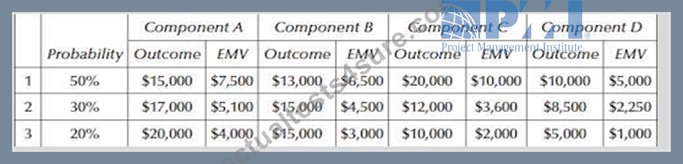
- A. Component C
- B. Component B
- C. Component D
- D. Component A
Answer: D
NEW QUESTION 239
In managing strategic change, the portfolio manager performs stakeholder analysis in order to consider the changing requirements. Which of the following options is referenced in this case to provide guidance on the communication required to ensure successful change?
- A. Portfolio Strategic Plan
- B. Portfolio Management Plan
- C. Portfolio Charter
- D. Portfolio Roadmap
Answer: B
Explanation:
Explanation
What is needed in this scenario is the communication management plan which offers guidelines and approaches on the needed communications for all aspects (Change, risk, etc.), which is a subsidiary plan of the portfolio management plan
NEW QUESTION 240
You have been asked to manage a major portfolio in order to salvage the company and and re-align it with the strategic objectives and goals. You decided to develop the strategic documents and are currently developing the charter. As a portfolio manager, which of the following would be your answer when asked of the purpose for the development of portfolio charter?
- A. Develop portfolio structure
- B. Start the development of Portfolio Management plan and all of its subsidiary plan
- C. Execute portfolio management processes
- D. Authorize portfolio components
Answer: C
NEW QUESTION 241
After a strategic change is managed and finalized, you as a portfolio manager, are expected to document changes to the portfolio components attributes. Which of the following is the document in which you document these changes?
- A. Portfolio updates
- B. Portfolio Management Plan updates
- C. Portfolio Process Assets updates
- D. Portfolio Strategic Plan updates
Answer: A
Explanation:
Explanation
Portfolio components and their attributes are part of the portfolio itself. Portfolios include a list of components with attributes: costs, time, resources, velocity of the component's completion, relationships, ranking criteria, priorities, dependencies, goals , organization area, rationale for the Add/Remove components decision, portfolio component budget and resource approvals or exceptions, etc.
NEW QUESTION 242
In a portfolio, data is an abundant asset, and managing the information aiming for a better decision making is critical. Which of the following help you with managing the portfolio value?
- A. Scenario Analysis, Capability & Capacity Analysis, Quantitative & Qualitative
- B. PMIS, Elicitation techniques, Communication Requirements Analysis, Communications Methods
- C. Elicitation techniques, Communication Requirements Analysis, Stakeholder analysis
- D. Elicitation techniques, Capability & Capacity Analysis, PMIS
Answer: B
NEW QUESTION 243
Portfolio managers tend to use the efficient frontier analysis as a modeling approach that gives decision makers the analytical tool to optimize portfolios given resource constraints such as risk. In which of the Portfolio management processes the efficient frontier is mostly used
- A. Optimize Portfolio
- B. Manage Portfolio value
- C. Manage Portfolio Information
- D. Manage Supply & Demand
Answer: B
Explanation:
Explanation
This is a tricky question. You should note here that the efficient frontier main purpose is to get the highest return for a given/acceptable level of risk. The Efficient Frontier is a method used in Value Scoring and Measurement Analysis in the "Manage Portfolio Value" process
NEW QUESTION 244
One of the key stakeholders came to you asking you to add more metrics because she thinks that it would give the portfolio management a better view of the actual progress. For her the more metrics you have the better.
What should your opinion be regarding this?
- A. You should disagree and escalate this to the governance board
- B. You should agree as having more metrics is better and because you do not want to say no to a key stakeholder
- C. You should disagree and communicate a clear message to the stakeholder that it does not matter how many metrics you have as long as you can fully report the progress
- D. You should agree, as having more metrics is better
Answer: C
Explanation:
Explanation
It does not matter how many metrics you have as long as you have it all covered. The scenario here does not require escalation.
The portfolio management office should be prepared to develop new metrics when appropriate and delete or change metrics that are no longer relevant to the stakeholders or that no longer support the organizational strategy and objectives. The quantity of metrics should not overwhelm the stakeholders to ensure the metrics are actively tracked and understood.
NEW QUESTION 245
A new portfolio manager in your organization is currently preparing his portfolio charter and has come to you asking advice about what should be present in charter
- A. Justification, Scenario Analysis
- B. Justification, Scenario Analysis, Capability & Capacity Analysis
- C. Key dependencies, critical success criteria, high-level timelines
- D. All internal and external dependencies, components fixed timelines
Answer: C
Explanation:
Explanation
Justification is correct, however the other points in the options are tools and techniques used and not content.
Charter contains the portfolio vision, objectives, portfolio justification, key and major stakeholders, stakeholder expectations and requirements, communication requirements, high-level scope, benefits, critical success criteria, resources, high-level timeline, and assumptions, constraints, dependencies, and risks
NEW QUESTION 246
As a portfolio manager you try to use all the information available to you in order to get the best out of the existing information and to better plan and manage the portfolio. The Enterprise Environmental Factors are important and referenced throughout the portfolio life cycle. Which of the following is correct regarding their purpose and focus?
- A. Forecasts how and when the portfolio will deliver value to the organization
- B. High-level prioritization mapping of the portfolio
- C. Organization's overall governance processes
- D. Establish communication requirements
Answer: C
Explanation:
Explanation
The EEFs are internal or external conditions, not under the control of the portfolio organization, which influence, constrain, or direct a portfolio's success. They include: Organizational overall governance processes, culture, and detailed hierarchy structure; Legal constraints; Governmental or industry standards; Infrastructure; Existing human resources; Personnel administration; Marketplace conditions; Portfolio management information system; Commercial databases; Organizational project management; Stakeholder risk tolerances; organization culture and structure, infrastructure, OPM, legal and regulatory considerations, industry requirements; Published information, including commercial databases, academic studies, market research, and bench-marking
NEW QUESTION 247
The portfolio manager defines the portfolio based on a listing of already existing work in the organization and selects the right components in order to be able to prioritize them. What do you use for defining the portfolio based on the listing of work?
- A. Portfolio Component Inventory
- B. Prioritization
- C. Elicitation technique
- D. Inventory of Work
Answer: A
NEW QUESTION 248
Although it has taken significant time, you and your team inventoried all the work under way in your new product development company. This list of components should be:
- A. Part of the portfolio management plan
- B. Included in the portfolio roadmap
- C. Maintained by the portfolio manager and continually updated
- D. Prioritized for effective resource allocation
Answer: D
NEW QUESTION 249
You are managing a complex portfolio with high risk levels due to emerging technological breakthroughs and a short benefit window to market your product. You know that managing risk is key to success and you are coaching your team on the same. You are currently in the process of developing the risk management plan.
Which of the following activities will you be performing?
- A. Risk Response
- B. All of the options
- C. Risk Assessment
- D. Risk Planning
Answer: D
NEW QUESTION 250
......
PfMP Dumps 100 Pass Guarantee With Latest Demo: https://www.actualtests4sure.com/PfMP-test-questions.html
PfMP Dumps PDF - PfMP Real Exam Questions Answers: https://drive.google.com/open?id=144_ZYAI3EWhwrJVU6Hpqc1p2x0GdJW8h
