

F5 Networks Certification Study Materials 301 Dumps | Updated Oct 10, 2021 - Actualtests4sure
Master 2021 Latest The Questions F5 Networks Certification Study Materials and Pass 301 Real Exam!
NEW QUESTION 15
Which statement is true regarding OneConnect processing?
- A. Client-side request can utilized existing server-side connections.
- B. The number of client connection is reduced.
- C. Server-side request can utilize existing client-sid connections.
- D. The virtual server must have UDP profile.
Answer: A
NEW QUESTION 16
When a pool is created and saved to file, where is the default file and location for the pool configuration? When a pool is created and saved to file, where is the default file and location for the pool configuration?
- A. /config/BigDB.dat
- B. /etc/bigip_base.conf
- C. /config/bigip_base.conf
- D. lconfig/bigip.conf
Answer: D
NEW QUESTION 17
Why would an administrator capture monitor traffic between a BIG-IP and servers?
- A. Viewing monitor traffic could help the administrator to define a more robust monitor.
- B. If client traffic to servers was failing, viewing and analyzing monitor traffic would determine the reason.
- C. Only client traffic may be captured; monitor traffic may not be captured.
- D. If a client were having difficulty logging into a load-balanced SSH server, viewing and analyzing the connection process would determine the reason.
Answer: A
NEW QUESTION 18
A, steaming profile will do which of the following?
- A. Search and replace the first occurrence of a specified of a specified string in either a request or response processed by a virtual server.
- B. Search and replace all occurrences of a specified string only in request processed by a virtual server.
- C. Search and replace all occurrences of a specified string only is responses processed by a virtual server.
- D. Search and replace all occurrences of a specified string in requests and responses processed by a virtual server.
Answer: D
NEW QUESTION 19
Could an iRule perform persistence based on a cookie?
- A. Yes. An iRule could be desiged to persist based on the contents of a cookie.
- B. No. Cookie persistence is only is based on a cookie persistence profile.
- C. No. iRules cannot affect persistence.
- D. Yes An iRule could be designed to persist based on the contents of a cookie.
Answer: A
NEW QUESTION 20
Which statement is true concerning SNATs using SNAT pools and SNATs using automap?
- A. SNAT s using a SNAT pool translate source addresses randomly to any of the addresses in the SNAT pool.
- B. A .SNAT pool can contain virtual server addresses.
- C. SNAT s using automap translate source addresses randomly to any of the BIG-IP's floating self-IP addresses.
- D. SNAT s using automap preferentially translate source addresses to non-floating self-IP addresses.
Answer: D
NEW QUESTION 21
Which statement describes advanced shell access correctly?
Which statement describes advanced shell access correctly?
- A. Users with advance shell access have the same right as those with msh access, but the right extend to all partition rather than to Users with advance shell access have the same right as those with msh access, but right extend to all partition rather than to a single partition.
- B. Users with advance shell access are limited to changing, adding, or deleting LTM object in any single partition. Users with? Advance shell accesses are limited to changing, adding, or deleting LTM object on any single partition.
- C. Users with advanced shell access can always change, add, or delete LTM objects in all partition. Users with? Advanced shell access can always, change, add, or delete LTM objects in all partitions.
- D. All Users can be given advanced shell access. All users can be given advance shell access.
Answer: C
NEW QUESTION 22
How is traffic flow through transparent virtual servers different from typical virtual servers?
- A. the value in the tcp acknowledgement field
- B. any bytes within the initial client request packet
- C. an IP address
- D. any text string within a cookie
Answer: C,D
NEW QUESTION 23
How is traffic flow through transparent virtual servers different from typical virtual servers?
- A. Traffic flow through transparent virtual severs is not load balabced.
- B. traffic flow through transparent virtual servers must be forwarded through a single routing device.
- C. Traffic flow through transparent virtual servers is bridged ( leave IP and MAC.addresses intact) rather than routed (leave IP address intact but change the MAC.addresses).
- D. traffic flow through transparent virtual servers soes not have IP address translation performed.
Answer: D
NEW QUESTION 24
Which three files/data items are included in a BIG-IP UCS backup file? (Choose three.)
- A. the BIG-IP default traps
- B. the BIG-IP license
- C. the BIG-IP host name
- D. the BIG-IP log files
- E. the BIG-IP administrative addresses
Answer: B,C,E
NEW QUESTION 25
QUESTION NO: 34. Click the Exhibit Button an LTM has the 3 virtual servers, a SNAT defined, four self IP addresses defined and the networks shown in the exhibit. Selected options for each object are shown below. Settings not shown are at their defaults. VirtualServer 1 Destination: 10.10.1.102:80 netmask 255.255.255.255 Pool: Pool with 3 members in the 172.16/16 network SNAT Automap enabled VirtualServer2 Destination: 10.10.1.102:* netmask 255.255.255.255 Pool: Pool with 3 members in the 192.168/16 network VirtualServer 3 Destination: 10.10.2.0:80 netmask 255.255.255.0 Type: IP Forwarding SNATI Source IP: All Addresses SNAT Address: SNAT Pool with 2 members -
172.16.20.50 and
192.168.10.50 Self IPs 192.168.1.1; 172.16.1.1; 10.10.2.1; 10.10.1.1 A connection attempt is made with a source IP and port of 10.20.100.50:80 and a destination IP and port of 10.10.2.10:80. When the request is processed, what will be the source and destination IP addresses?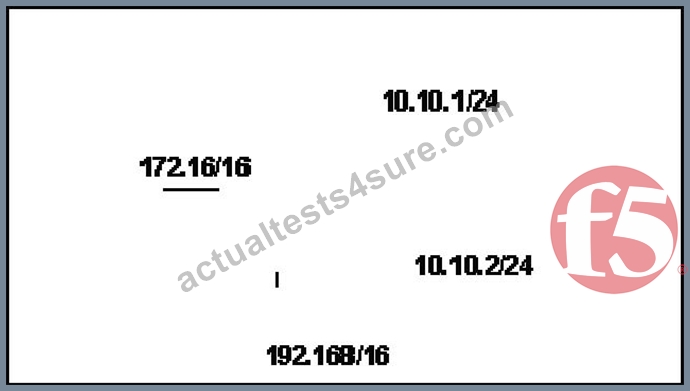
- A. The request will be dropped.
- B. Source IP: 10.20.100.50; Destination IP: 10.10.2.10
- C. Source IP: Either 172.16.20.50 or 192.168.10.50; Destination IP: 10.10.2010
- D. Source IP: 10.10.2.1; Destination IP: 10.10.2.10
Answer: C
NEW QUESTION 26
An LTM has the 3 virtual servers, four self IP addresses defined and the networks shown in the exhibit. Selected options for each object are shown below. Settings not shown are at their defaults. VirtualServerl Destination: 10.10.2.102:443 netmask 255.255.255.255 Pool: Pool with 3 members in the 172.16/16 network VirtualServer2 Destination: 10.10.2.102:* netmask 255.255.255.255 Pool: Pool with 3 members in the 192.168/16 network VirtualServer3 Destination: 10.10.2.0:80 netmask 255.255.255.0 Type: IP Forwarding SNAT1 Source IP: All Addresses SNAT Address: SNAT Pool with 2 members - 172.16.20.50 and 192.168.10.50 Self IPs 192.168.1.1; 172.16.1.1; 10.10.2.1;
10.10.1.1 A connection attempt is made with a source IP and port of 10.20.100.50:2222 and a destination IP and port of 10.10.2.102:80. When the request is processed, what will be the destination IP address?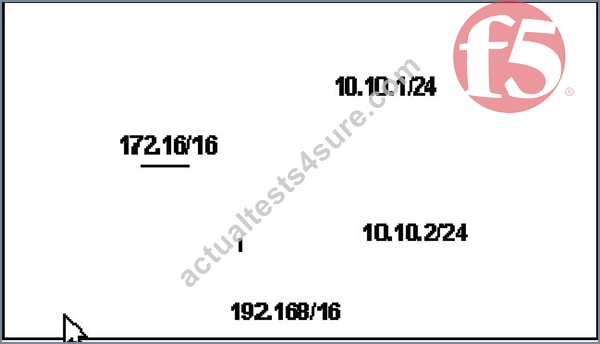
- A. Destination IP: pool member in the 192.168/16 network
- B. Destination IP: 10.10.2.102
- C. The request will be dropped.
- D. Destination IP: pool member in the 172.16/16 network
Answer: A
NEW QUESTION 27
What occurs when a load?command is issued?What occurs when a ? load?command is issued?
- A. the running configuration is replaced by the configuration in the files, but only if they are syntactically correct.
- B. The running configuration is replaced by the any portion of the configuration files that are syntactically correct.
- C. The running configuration is compared to the configuration in files and, when changes are noted, the version in the files is loaded over what is in money.
- D. The running configuration is loaded into files for storage.
Answer: A
NEW QUESTION 28
Given the configuration shown below, if a connection request arrived on the BIG-IP with a source address of 200.10.10.10:1050 and a destination of 150.10.10.75:80, what would the source IP address of the associated packet be when it arrived on the choosen member of the web_pool self
150.10.10.1 { netmask 255.255.255.0 unit I floating enable vlan external allow tcp https } self
10.10.1.1 { netmask 255.255.255.0 unit I floating enable vlan internal allow default } pool web_pool { member 10.10.1.11:80 member 10.10.1.12:80 member
10.10.1.13:80 }snatpool client_pool { member 10.10.1.100 member 150.10.10.15 } virtual VS_web { destination 150.10.10.10:80 ip protocol tcp snat automap pool web_pool }virtual VS_network{ destination 150.10.1 0.0:any mask
255.255.255.0 snatpool client_pool ip protocol tcp pool web_pool } virtual VS_network { destination 150.10.1 0.0:any mask 255.255.255.0 snatpool client_pool ip protocol tcp pool web_pool } virtual VS_network { destination 150.10.10.0:any mask 255.255.255.0 snatpool client_pool ip protocol tcp pool web_pool }
- A. 200.10.10.I0D.200.10.10.10
- B. 150.10.10.15C.150.10.10.15
- C. 10.10.1.I10.10.1.1
- D. 10.10.1.I00B.10.10.1.100
Answer: D
NEW QUESTION 29
A BIG-IP has the following objects configured: A SNAT pool with 2 members:
150.10.33.33 and 10.10.1.33 A load-balancing pool with 5 members:
10.10.1.1-10.10.1.5:80
The BIG-IP has two self-IP addresses: 150.10.10.10 and 10.10.1.10 A virtual server at 150.10.30.30:80 that is associated with both the SNAT pool and the load-balancing pool. If a client at IP address 200.10.10.10 initiates a connection to the virtual server, what will the source IP address be in the packets sent to the chosen pool member?
- A. 150.10.30.30
- B. 200.10.10.10
- C. 10.10.1.33
- D. It could be any of the addresses of the members of the load-balancing pool.
- E. 150.10.33.33
- F. 10.10.1.10
Answer: C
NEW QUESTION 30
Which statement is true concerning packet filters?
- A. Filters cannot prevent access to the management port.
- B. The order of filters does not affect which traffic is accepted or denied
- C. In addition to administrator-created filters, three always exists a "deny all" filter that processes traffic last.
- D. Filters cannot prevent the BIG_IP synching process from taking place.
Answer: A
NEW QUESTION 31
Which is a potential result when a trunk is configured on a BIG-IP?
- A. Packets flowing to the VLAN could arrive on any of the interfaces in the trunk
- B. VLAN fail-safe is not available for any VLAN associated with any trunks.
- C. Since any VLANs associated with the trunk are necessarily associated with multiple interfaces, the VLAN using the must use tagged packets.
- D. No additional trunks can be configuration since each BIG-IP is limited to one trunk
Answer: A
NEW QUESTION 32
......
A fully updated 2021 301 Exam Dumps exam guide from training expert Actualtests4sure: https://www.actualtests4sure.com/301-test-questions.html
Practice To 301 - Actualtests4sure Remarkable Practice On your LTM Specialist Exam Exam: https://drive.google.com/open?id=1X-uzOJXiFzo7wHpg5j1XMdKefqyiy0Xz
