

Pass ACD200 Exam with Updated ACD200 Exam Dumps PDF 2023
ACD200 Exam Dumps - Free Demo & 365 Day Updates
NEW QUESTION # 10
You create an Integration that modifies the data.
In which three locations can it be called? (Choose three.)
- A. Expression or Rule
- B. Web API (GET)
- C. Web API (POST, PUT, DELETE)
- D. SAIL saveinto parameter
- E. Process model
Answer: A,C,E
NEW QUESTION # 11
You are troubleshooting slow response times on a SAIL interface.
What are two potential causes of the performance issues? (Choose two.)
- A. Multiple rule inputs
- B. Stacked button layout
- C. Configuration of refresh variables
- D. Multiple a!save operations
Answer: C,D
NEW QUESTION # 12
You are tasked with configuring a process model to store the result of an expression rule for every item in a list.
Which process model design has the lowest memory footprint?
- A. Create a loop of smart service nodes in the process model and execute it for each item in the list.
- B. Call a sub-process for each item in the list.
- C. Configure a script task to use a!foreach to iterate over each item in the list.
- D. Run MNI over a script task for each item in the list.
Answer: C
Explanation:
Explanation
The question is about designing a process model to store the result of an expression rule for every item in a list with the lowest memory footprint. The best design for this purpose is to configure a script task to use a!foreach to iterate over each item in the list, as it allows you to execute an expression rule for each element of an array without creating multiple nodes or subprocesses in the process model. A script task is a node that executes an expression without user interaction, and a!foreach is a function that applies an expression to each element of an array and returns an array of results. The other options are not optimal for this purpose, as they either create more nodes or subprocesses in the process model, which consume more memory and resources.
References:
* Script Task
* a!foreach()
NEW QUESTION # 13
Your organization is considering automating the running of expression rule test cases to provide unit tests for your Appian applications.
Which three methods could be used to launch a test run when required? (Choose three.)
- A. A process model invoked via an API.
- B. Via the DevOps section of the Administration Console.
- C. A web hook from a content versioning system (CVS).
- D. A SAIL interface embedded in a report.
- E. A process model exposed to users as an action.
Answer: B,D,E
NEW QUESTION # 14
You need to create a service account for a consumer to access the Appian Web API.
Which user type should be created?
- A. System Administrator
- B. Basic User
- C. Initiator
- D. Editor
Answer: B
NEW QUESTION # 15
You need to create a plug-in to perform a job in the background. The plug-in should not be available under an expression rule, connected system, or the process model.
What type of plug-in should you create? (Choose the best answer.)
- A. Smart service
- B. Function
- C. Servlet
- D. Connected systems
Answer: C
NEW QUESTION # 16
You are creating an expression rule that will be reused throughout your environment.
What are two benefits of including meaningful test cases when creating a new expression rule? (Choose two.)
- A. Speed up unit, regression, and exploratory testing.
- B. Increase code quality.
- C. Improve the appearance of the code.
- D. Improve performance.
Answer: A,B
NEW QUESTION # 17
You are troubleshooting a process model instance with an error in a node.
Which two options will allow you to obtain more information about the error? (Choose two.)
- A. View the process model properties.
- B. Open the process model from the process instance.
- C. View the properties dialog of the affected node.
- D. View the Process Details dialog.
Answer: C,D
NEW QUESTION # 18
Which two statements about the a!queryEntity() function are true? (Choose two.)
- A. Setting the fetchTotalCount parameter to False can improve the performance of the rule.
- B. The queries defined using the query parameter return a constrained subset of matching data records by default.
- C. The entity value must be given as a constant of type Data Store Entity.
- D. The queries defined using the query parameter are not limited in how long they wait to return results.
Answer: A,C
Explanation:
Explanation
The two statements about the a!queryEntity() function that are true are:
* The entity value must be given as a constant of type Data Store Entity. This is because the entity value specifies which data store entity (table or view) to query from. The value must be a constant that references an existing data store entity in Appian Designer. You cannot use a variable or an expression for this value.
* Setting the fetchTotalCount parameter to False can improve the performance of the rule. This is because setting this parameter to False tells Appian not to calculate the total number of records that match the query criteria, which can be an expensive operation for large data sets. By default, this parameter is set to True, which means Appian will return the total count along with the query results.
References: a!queryEntity() Function
NEW QUESTION # 19
You are facing issues when attempting to establish a SAML connection to an identity provider. You determine you need to increase the authentication-specific logging levels so that you can view trace level statements about the connection attempt in the application server log.
Which property file should you update to modify the log output level? (Choose the best answer.)
- A. appian_log4j.properties
- B. commons-logging.Properties
- C. custom.properties
- D. logging.properties
Answer: A
Explanation:
Explanation
The appian_log4j.properties file is used to configure the logging levels for Appian components, including authentication. You can modify this file to increase or decrease the verbosity of the log output for different categories. For example, to enable trace-level logging for SAML authentication, you can add this line to the file: log4j.logger.com.appiancorp.suite.authentication.saml=TRACE References: [Appian Logging Configuration], [SAML Troubleshooting]
NEW QUESTION # 20
You need to find a list of expression rules that are causing performance issues, or have caused performance issues in the last 30 days.
What should you do?
- A. Observe the runtime of all test cases.
- B. Inspect the application server log.
- C. Use the Monitoring tab to find rules with a low completion percentage.
- D. Access the Rule Performance tab in the Administration Console.
Answer: D
Explanation:
Explanation
The requirement is to find a list of expression rules that are causing performance issues, or have caused performance issues in the last 30 days. The best way to do this is to access the Rule Performance tab in the Administration Console, as it provides a dashboard that shows the execution time, frequency, and impact of expression rules in a given time period. You can filter the rules by application, rule type, or execution time, and sort them by various metrics. You can also drill down into each rule to see the details of its executions and test cases. The other options are not as effective or convenient for this purpose, as they either do not provide enough information, require manual inspection, or are not related to expression rules. References:
* Rule Performance
NEW QUESTION # 21
You are designing a repeating step in a process.
What is the default limit for maximum number of node executions?
- A. 0
- B. 1
- C. 2
- D. 3
Answer: A
Explanation:
Explanation
The question is about the default limit for maximum number of node executions in a repeating step in a process. The default limit is 1000, as it is the value of the system property conf.bpm.maxNodeExecutionsPerInstance, which controls how many times a node can be executed in a single process instance. This limit is intended to prevent infinite loops or excessive node executions that could affect the performance or stability of Appian. The other options are not correct, as they are either too high or too low. References:
* Repeating Steps in Processes
* System Properties Reference
NEW QUESTION # 22
A lead designer receives this requirement:
Every time a record is modified, the data changed must be stored for audit.
Which design is the most efficient and has the least impact on the Appian application? (Choose the best answer.)
- A. Create a custom plugin that can write an audit trail to a log file.
- B. Create a web API call to an audit history system and write the audit trail to file.
- C. Create an Appian process to capture the change history and write the audit trail to the database.
- D. Create a trigger on the database table to capture the audit trail to a table.
Answer: D
NEW QUESTION # 23
During the design review, you identified slow-operating expression rules querying a specific data store.
Which metric from the data_store_details.csv file will help you understand the "number of operations against data store?" (Choose the best answer.)
- A. Transform Count
- B. Total Count
- C. Execute Count
- D. Query Count
Answer: B
NEW QUESTION # 24
Using a View, you pull a report on different employee transactions. You receive the following error:
"a!queryEntity: An error occurred while retrieving the data."
What is the most likely root cause? (Choose the best answer.)
- A. The rule contains a missing syntax.
- B. The required inputs were not provided.
- C. The view doesn't have a column mapped as a Primary Key in its corresponding CDT.
- D. The view contains a large number of rows, requiring more time to fetch the data.
Answer: D
NEW QUESTION # 25
There is a need to relate two entities in the data structure: Employee and Skill.
Employees can have multiple skills, and a single skill can relate to multiple employees.
What kind of relationship would these entities have, and what is the minimum number of tables required to implement the design, according to Appian best practices? (Choose the best answer.)
- A. Many-to-many; 2 tables
- B. One-to-many; 2 tables
- C. Many-to-one; 2 tables
- D. Many-to-many; 3 tables
Answer: D
Explanation:
Explanation
A many-to-many relationship is a type of relationship where multiple records in one table are associated with multiple records in another table. To implement a many-to-many relationship, a third table is needed to store the associations between the two entities. In this case, the third table would store the employee ID and the skill ID for each pair of employee and skill. This design allows for efficient querying and updating of the data, as well as avoiding data redundancy and inconsistency.
NEW QUESTION # 26
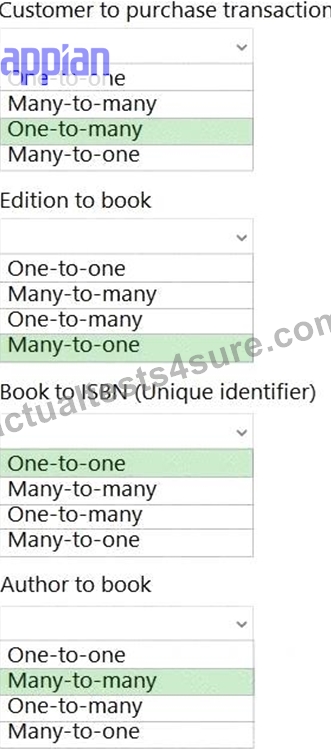
HOTSPOT
You need to create and design an ERD that represents the client's bookstore inventory.
Match the entity descriptions to the most appropriate relationship. Each relationship type will be used once.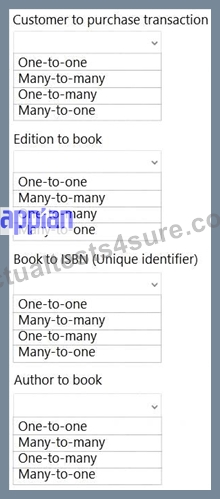
Answer:
Explanation: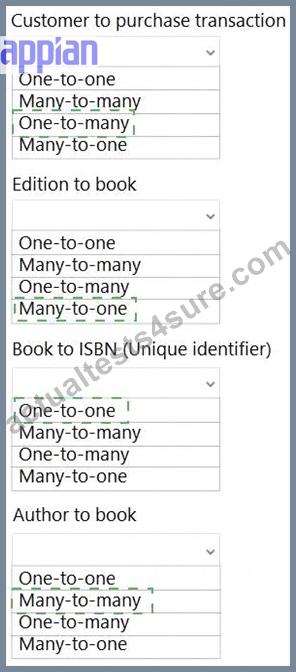
NEW QUESTION # 27
An organization has decided to integrate with a third-party to scan incoming documents and capture the details in a table called [appian].[document]. Each document will form a new case in Appian to be displayed on a Record List.
The record needs to show data from both [appian].[document] and [appian].[caseData], which holds additional case information.
What is the most efficient way to achieve this?
- A. Create a SSIS package to run at a regular interval.
- B. Create a stored procedure to query the data from both the [appian].[document] and [appian].[caseData] tables.
- C. Create a trigger on the [appian].[document] table to copy all the data across to the [appian].[caseData] table and point the record at [appian].[caseData].
- D. Create a view between both the [appian].[document] and [appian].[caseData] tables to feed the record.
Answer: D
Explanation:
Explanation
The most efficient way to achieve the integration between the third-party document scanner and the Appian record list is to create a view between both the [appian].[document] and [appian].[caseData] tables to feed the record. A view is a virtual table that is defined by a query and does not store any data. It can join, filter, aggregate, or transform data from one or more tables and present it in a desired format. A view can be used to simplify complex queries, provide security, or enhance performance. By creating a view, the record can show data from both tables without duplicating or copying any data. Therefore, the correct answer is C.
References:
* Relational Database Guidance
* Views
NEW QUESTION # 28
There is a need to relate two entities in the data structure: Employee and Skill.
Employees can have multiple skills, and a single skill can relate to multiple employees.
What kind of relationship would these entities have, and what is the minimum number of tables required to implement the design, according to Appian best practices? (Choose the best answer.)
- A. Many-to-many; 2 tables
- B. One-to-many; 2 tables
- C. Many-to-one; 2 tables
- D. Many-to-many; 3 tables
Answer: D
NEW QUESTION # 29
A user is uploading a document in the Appian environment and wants to restrict the uploading of documents without extensions.
How can this be done at the environment level?
- A. Configure Validation rules wherever required.
- B. No actions are required from the developer; Appian auto-validates these documents.
- C. Enable File Upload > Block files without an extension, under Administration Console.
- D. Document can be uploaded but cannot be restricted.
Answer: C
Explanation:
Explanation
The best way to restrict the uploading of documents without extensions at the environment level is to enable the File Upload > Block files without an extension option under the Administration Console. This option will prevent users from uploading files that do not have a valid file extension, such as .docx, .pdf, or .png. This can help to avoid security risks and compatibility issues with unsupported file types. Therefore, the correct answer is A.
References:
* [File Upload Settings]
* [File Extensions]
NEW QUESTION # 30
You are troubleshooting a process model instance with an error in a node.
Which two options will allow you to obtain more information about the error? (Choose two.)
- A. View the process model properties.
- B. Open the process model from the process instance.
- C. View the properties dialog of the affected node.
- D. View the Process Details dialog.
Answer: C,D
Explanation:
Explanation
When troubleshooting a process model instance with an error in a node, two options that can provide more information about the error are to view the Process Details dialog and to view the properties dialog of the affected node. The Process Details dialog shows the status, history, and variables of the process instance, as well as any errors or warnings that occurred during the execution. The properties dialog of the affected node shows the configuration, inputs, outputs, and expressions of the node, as well as any errors or warnings that occurred during the evaluation. These options can help to identify the cause and location of the error, and to apply any necessary fixes. Therefore, the correct answers are B and D.
References:
* [Process Details Dialog]
* [Properties Dialog]
NEW QUESTION # 31
......
ACD200 Dumps - Pass Your Certification Exam: https://www.actualtests4sure.com/ACD200-test-questions.html
Free Sales Ending Soon - Use Real ACD200 PDF Questions: https://drive.google.com/open?id=171XEobcRZjoxU_hBfWgi37dVI1qPUJaN
