

Free IFSE Institute CIFC Study Guides Exam Questions and Answer
CIFC Exam Dumps, CIFC Practice Test Questions
IFSE Institute CIFC Exam Syllabus Topics:
| Topic | Details |
|---|---|
| Topic 1 |
|
| Topic 2 |
|
| Topic 3 |
|
| Topic 4 |
|
| Topic 5 |
|
| Topic 6 |
|
| Topic 7 |
|
NEW QUESTION # 76
Sean purchases 500 units of Penn Canadian Equity Fund when the net asset value per unit (NAVPU) is
$16.70. On December 15, the mutual fund's NAVPU is $21. On December 16, the mutual fund declares a distribution of $1.25 per unit. Sean's distribution is immediately reinvested and he purchases additional units of the mutual fund.
Which of the following statements about the effect of the distribution is correct?
- A. After the distribution. Sean will have J&625 in cash and JB8.350 worth of the Penn Canadian Equity Fund.
- B. The total value of Sean's mutual fund holdings after the distribution and reinvestment is $9,875.
- C. The NAVPU of the mutual fund does not change after the distribution since Sean reinvests his distribution and purchases additional units.
- D. Sean's distribution is reinvested at a NAVPU of $19.75 and he receives approximately 31.65 additional units.
Answer: D
Explanation:
Explanation
Sean's distribution is reinvested at a NAVPU of $19.75 and he receives approximately 31.65 additional units.
When a mutual fund declares a distribution, it reduces its NAVPU by the amount of the distribution per unit.
In this case, the NAVPU drops from $21 to $19.75 after the distribution of $1.25 per unit. Sean's distribution is $625 ($1.25 x 500 units), which he reinvests in the mutual fund at the new NAVPU of $19.75. He receives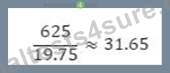
additional units. The total value of Sean's mutual fund holdings after the distribution and reinvestment is (500+31.65)*19.75=$10,500
, not $9,875. The NAVPU of the mutual fund does change after the distribution, regardless of whether Sean reinvests his distribution or not. References: [Unit 7: Mutual Funds Administration]
NEW QUESTION # 77
Kerry's total income this past year was $100,000 and she claimed a tax deduction of $2,000. When the tax return is filed, what would be the federal tax payable when applying the following federal tax rates?
(Round to the closest whole dollar for the final answer.)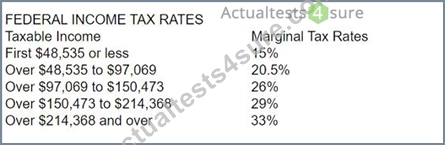
- A. $17,472
- B. $18,754
- C. $25,480
- D. $24,000
Answer: B
Explanation:
Explanation
Kerry's taxable income would be $98,000 ($100,000 - $2,000). Using the federal tax rates provided in the image, the first $48,535 of her income would be taxed at 15%, the next $48,534 at 20.5%, and the remaining
$931 at 26%. This would result in a total federal tax payable of $18,754. You can see the calculation in detail below:
Taxable Income
Marginal Tax Rate
Federal Tax Payable
$0 - $48,535
15%
$7,280.25
$48,536 - $97,069
20.5%
$9,934.47
$97,070 - $98,000
26%
$539.80
Total
$18,754.52
Note: The final answer is rounded to the closest whole dollar.
References: Canadian Investment Funds Course, Unit 8, Section 8.2; [4]
NEW QUESTION # 78
Patrick is a portfolio manager for the HyperTally Growth Fund. It has generated an annualized rate of return of
10% this past year. However, with the anticipation of very high inflation to soon occur, there is also an expectation of higher interest rates. Patrick is concerned about the future returns of existing stocks within the fund. What may Patrick do to protect against the market value of the fund dropping?
- A. Buy call options for the existing stocks stored within the fund.
- B. Agree to buy forward contracts where he is in the "long' position.
- C. Avoid the use of derivatives because they are speculative in nature.
- D. Purchase put options for the fund's existing assets.
Answer: D
NEW QUESTION # 79
Natasha currently owns 2 mutual funds: a bond fund and a Canadian equity fund. She would like to use one of them as her registered retirement savings plan (RRSP) contribution for the year. From a tax efficiency perspective, which mutual fund should she contribute?
- A. it depends on her marginal tax rate
- B. either since it makes no difference
- C. the equity fund
- D. the bond fund
Answer: D
Explanation:
Explanation
The bond fund should be contributed to Natasha's RRSP from a tax efficiency perspective, because interest income from bonds is fully taxable at her marginal tax rate outside of an RRSP. By contributing the bond fund to her RRSP, Natasha can defer paying tax on the interest income until she withdraws it from her RRSP in retirement, when she may be in a lower tax bracket. The equity fund should be kept outside of her RRSP, because dividends and capital gains from equities receive preferential tax treatment compared to interest income. Dividends qualify for the dividend tax credit and capital gains are only 50% taxable. Furthermore, equities tend to have higher returns than bonds over the long term, which means that Natasha would have more after-tax income by keeping them outside of her RRSP. References: Registered Retirement Savings Plan (RRSP), Does it pay to invest in an RRSP? Here's the math
NEW QUESTION # 80
Khuyen is a Dealing Representative for Stark Contrast Investments. Her dealer has relationships with 20 different mutual fund families. This gave her the flexibility to sell two different types of funds from two different fund families to her client, Bao. $5,000 was invested in the Blue Moon Global Balanced fund and an additional $5,000 was invested in the Orange Sun Asset Allocation fund. Khuyen has been reviewing the performance of both funds and has determined that Bao would be better off being fully invested in the Blue Moon Global Balance fund. Bao had previously signed a Limited Authorization Form (LAF) for Khuyen, so she goes ahead and does not worry about consulting with Bao before making the change.
What type of activity has Khuyen performed?
- A. Value investing
- B. Churning
- C. Discretionary trading
- D. Top-down management
Answer: C
Explanation:
Explanation
Discretionary trading is a type of trading activity where the advisor makes investment decisions on behalf of the client without obtaining the client's prior consent for each transaction. Discretionary trading is only allowed if the client has signed a discretionary management agreement with the advisor and the advisor is registered as a portfolio manager. A limited authorization form (LAF) does not grant the advisor the authority to engage in discretionary trading. A LAF only allows the advisor to execute trades that are initiated by the client, such as pre-authorized contributions or withdrawals. Therefore, Khuyen has performed discretionary trading by switching Bao's funds without consulting him, which is a violation of her registrant responsibilities and ethical standards. References:
Canadian Investment Funds Course (CIFC) Study Guide, Chapter 2: The Sales Process, Section 2.4:
Ethics and Compliance, page 2-161
Discretionary Trading Definition - Investopedia2
NEW QUESTION # 81
Reginald is a Dealing Representative, who feels pressure from management at the beginning of every calendar year, to open new registered retirement savings plans (RRSPs) and generate RRSP contributions. It is the end of February, and Reginald is close to reaching his personal sales objectives. He just finished an appointment with a prospective new client, Orel. Orel wants to open a tax-free savings account (TFSA) to build emergency savings. However, Reginald recommended to Orel that he should first contribute to an RRSP, and then use the tax savings for a TFSA contribution. With regards to account suitability, what can be said about Reginald's advice?
- A. Recommending an investment solution that addresses two needs, is putting Reginald's client's interest first.
- B. Reginald is putting the client's interest first by informing Orel why he should change his investment strategy.
- C. By convincing Orel to contribute to an RRSP, instead of a TFSA, Reginald has put his client's interest first.
- D. Based on Orel's stated need, recommending an RRSP contribution is unsuitable.
Answer: D
Explanation:
Explanation
Orel's goal is to build emergency savings, which means he needs a flexible and accessible account that does not penalize withdrawals. A TFSA is more suitable for this purpose, as it allows tax-free withdrawals at any time and does not affect other income-tested benefits. An RRSP, on the other hand, is designed for long-term retirement savings, and withdrawals are subject to income tax and withholding tax. Moreover, RRSP withdrawals reduce the contribution room permanently, and may affect eligibility for government benefits such as the Canada Child Benefit or the Guaranteed Income Supplement.
References = Canadian Investment Funds Course (CIFC) - Module 3: Registered Plans - Section 3.1:
Registered Retirement Savings Plan (RRSP)1 and Section 3.2: Tax-Free Savings Account (TFSA)2
1: https://www.ifse.ca/wp-content/uploads/2021/08/CIFC-Module-3.pdf 2:
https://www.ifse.ca/wp-content/uploads/2021/08/CIFC-Module-3.pdf
NEW QUESTION # 82
Loretta is looking for a well diversified equity fund. Her ideal mutual fund would hold investments within and outside Canada. Although she is seeking growth, Loretta also wants a mutual fund that invests in quality companies.
Which of the following mutual funds would be the best choice for Loretta?
- A. Polar Global Blue Chip Equity Fund - this global equity fund invests in large, established companies in mostly stable and mature foreign markets.
- B. Dominion International Growth Fund - this international equity fund invests in small and medium sized companies in countries all around the world.
- C. Lennox Energy Fund - this sector fund invests primarily in Canadian oil and gas companies that sell both to domestic and foreign markets.
- D. Auric Precious Metals Fund - this sector fund invests in Canadian companies that participate in the precious metals sector such as owning mines in foreign countries.
Answer: A
Explanation:
Explanation
Loretta is looking for a well diversified equity fund that invests both within and outside Canada. She also wants a fund that invests in quality companies, which implies that she prefers lower risk and higher stability. A global equity fund would meet her criteria, as it can invest in any country, including Canada, and diversify across different regions and markets. A global equity fund that focuses on large, established companies, also known as blue chip stocks, would also suit her preference for quality and stability, as these companies tend to have strong financial performance, competitive advantages, and consistent dividends. Therefore, the Polar Global Blue Chip Equity Fund would be the best choice for Loretta among the given options.
References: Canadian Investment Funds Course, Unit 6, Section 6.2
NEW QUESTION # 83
Gregory is a conservative investor who wants to hold a portfolio of equity securities that would fall less than the overall market in a downturn.
Which of the following portfolios would you advise Gregory to invest in?
- A. a portfolio with a beta greater than 2
- B. a portfolio with a beta between 1 and 2
- C. a portfolio with a beta equal to 1
- D. a portfolio with a beta less than 1
Answer: D
Explanation:
Explanation
A portfolio with a beta less than 1 would be suitable for Gregory, who is a conservative investor and wants to reduce his exposure to market risk. A beta less than 1 means that the portfolio is less volatile than the market index and tends to dampen its movements. This implies that the portfolio would fall less than the market in a downturn, but also rise less than the market in an upturn. A portfolio with a beta equal to 1 would move in the same direction and magnitude as the market, while a portfolio with a beta greater than 1 would be more volatile than the market and amplify its movements.
References: Canadian Investment Funds Course, Chapter 3: Risk and Return1
NEW QUESTION # 84
Which of the following statements is true when comparing fund of funds to traditional mutual funds?
- A. Since fund of funds invest primarily outside Canada, they will have higher fees than traditional mutual funds.
- B. Fund of funds have more fee structure options available and lower fees than traditional mutual funds.
- C. Fund of funds have more asset class options available and lower fees than traditional mutual funds.
- D. Fund of funds have higher fees than traditional mutual funds since there are two sets of management fees.
Answer: D
Explanation:
Explanation
A fund of funds is a mutual fund that invests in other mutual funds. This means that there are two levels of management fees: one for the fund of funds itself and one for the underlying funds. Therefore, fund of funds have higher fees than traditional mutual funds that invest directly in securities. References: Canadian Investment Funds Course (CIFC) | IFSE Institute, Unit 6, Lesson 2
NEW QUESTION # 85
Gershon is a Dealing Representative and he opens a new account for his client, Isaac. Gershon collects the necessary information from Isaac in order to designate the Trusted Contact Person (TCP) for Isaac's account.
Which of the following statements about Isaac's TCP is CORRECT?
- A. The TCP is an alternative authority on Isaac's account that has the power to place a temporary hold on Isaac's account to disallow trading.
- B. The TCP is an alternative to a Power of Attorney (PQA) and has the authority to make changes to Isaac's account and direct trading.
- C. The TCP is the person whom Gershon can speak to if he becomes concerned about Isaac's mental capacity to make financial decisions.
- D. The TCP is the person who is designated with authority to direct financial dealings for Isaac's account and make financial decisions.
Answer: C
Explanation:
Explanation
A Trusted Contact Person (TCP) is someone that an investor authorizes their brokerage firm to contact in limited circumstances, such as if the broker has trouble reaching the investor or has a reasonable belief that the investor's account may be exposed to possible financial exploitation. A TCP does not have the authority to make changes to the investor's account or direct trading, unlike a Power of Attorney (POA). A TCP also does not have the power to place a temporary hold on the investor's account, which is a decision made by the brokerage firm. Therefore, C is the correct answer. References: What is a Trusted Contact Person and why you should name one, Do You Need A 'Trusted Contact' To Help Protect You?, Investor Bulletin: Please Consider Adding a Trusted Contact Person to Your Account
NEW QUESTION # 86
Louis is the portfolio manager for Quattro Fund. The mandate of the mutual fund is to invest in a combination of cash, fixed income, and equity securities; however, Louis has the ability to adjust the portfolio according to market conditions. If Louis feels that interest rates will fall, he could invest the whole portfolio in equities. If he feels the market is too high, he could take profits and sit totally in cash. What type of mutual fund is Quattro Fund?
- A. asset allocation fund
- B. balanced fund
- C. Canadian equity fund
- D. commodity pool
Answer: A
Explanation:
Explanation
An asset allocation fund is a type of mutual fund that invests in a combination of cash, fixed income, and equity securities, but has the flexibility to adjust the portfolio according to market conditions and the fund manager's outlook. The fund manager can change the asset mix to take advantage of opportunities or reduce risks in different asset classes and markets. The fund's objective is to achieve a balanced risk-return profile by diversifying across different assets and investment styles. Quattro Fund is an example of an asset allocation fund, as it can invest in cash, fixed income, and equity securities, and Louis can adjust the portfolio according to his views on interest rates and the market.
References: Canadian Investment Funds Course, Unit 6, Section 6.2; 4; 5; 6
NEW QUESTION # 87
Which statement regarding the underwriting process and over-the-counter (OTC) markets is CORRECT?
- A. Corporations must have their shares listed both on an exchange and the OTC market during the underwriting process.
- B. During the underwriting process investment bankers raise investment capital from investors on behalf of corporations and governments issuing securities.
- C. Many new stock issues that are underwritten by securities firms are first listed on a stock exchange before they are sold over-the-counter.
- D. The disclosure standards for stock exchanges are not as stringent as those imposed by the OTC market.
Answer: B
Explanation:
Explanation
Underwriting is the process through which an individual or institution takes on financial risk for a fee. This risk most typically involves loans, insurance, or investments. In the case of securities, underwriting involves conducting research and assessing the degree of risk each applicant or entity brings to the table before assuming that risk. During the underwriting process, investment bankers raise investment capital from investors on behalf of corporations and governments issuing securities. They also help determine the company's underlying value compared to the risk of funding its IPO. References: Underwriting: Definition and How the Various Types Work - Investopedia, The future of insurance underwriting | Deloitte Insights
NEW QUESTION # 88
What information does Fund Facts provide to potential investors?
- A. How to calculate the taxes owed from investment income.
- B. The portfolio management strategy that is used.
- C. The remuneration paid to the Independent Review Committee.
- D. What the mutual fund is currently investing in.
Answer: D
Explanation:
Explanation
A Fund Facts document is a summary disclosure document that provides key information about a mutual fund, such as its investment objectives, risks, past performance, and fees. One of the information items that a Fund Facts document provides to potential investors is what the mutual fund is currently investing in, such as its top 10 holdings, asset mix, geographic allocation, and sector allocation. A Fund Facts document does not provide information on how to calculate taxes, portfolio management strategy, or remuneration of the Independent Review Committee. References: Fund facts guide | Sun Life Global Investments, Mutual Funds - Fund Facts | ScotiaFunds
NEW QUESTION # 89
What role do investment dealers play in the Canadian and global financial markets?
- A. They assist with the exchange of capital for a financial instrument.
- B. They are contributors to a company's profits.
- C. By underwriting financial instruments, they raise capital for investors.
- D. They are contributors to an investor's earnings.
Answer: A
Explanation:
Explanation
Investment dealers are people or firms who buy and sell securities for their own account, whether through a broker or otherwise. They play an important role in the Canadian and global financial markets because they are market makers, create liquidity, and help promote long-term growth in the market. They also provide investment services to investors, such as underwriting securities, raising capital, and offering advice. By assisting with the exchange of capital for a financial instrument, they facilitate the flow of funds between savers and borrowers, and between different sectors and countries. The other options are not accurate descriptions of the role of investment dealers. References: Dealers: Definition in Trading, Meaning and Comparison to Brokers, Investment Dealers Definition
NEW QUESTION # 90
Catarina is a Dealing Representative for Ethical Financial which represents 20 different mutual fund families.
Darlene is a fund manager from one of those mutual fund families and wants to send a gift card to Catarina as a symbol of appreciation. Ethical Financial's policies and procedures manual (PPM) require that Catarina decline the gift.
What method of addressing conflict of interest is being used by Ethical Financial?
- A. Potential
- B. Control
- C. Disclosure
- D. Avoidance
Answer: D
Explanation:
Explanation
Avoidance is a method of addressing conflict of interest by preventing it from occurring in the first place.
Ethical Financial's policies and procedures manual (PPM) require that Catarina decline the gift from Darlene, which is a potential source of conflict of interest. By doing so, Catarina avoids any appearance of favouritism or bias towards Darlene's mutual fund family. (Canadian Investment Funds Course, Chapter 2, Section 2.3) References:
Canadian Investment Funds Course, Chapter 2, Section 2.3: Conflicts of Interest IFSE Institute: Conflicts of Interest1
NEW QUESTION # 91
Manuel is a Dealing Representative for Commonwealth Financial Inc., a mutual fund dealer. His dealer represents many different mutual fund families available, including their own: CF Group of Funds. He is considering recommending a CF equity fund to one of his clients, Stefania. While describing details about the fund, he informs her that accounts are set-up in nominee name, and that their mutual funds are not transferable.
In addition, the fund does pay trailer fees.
What type of information has Manuel described about his potential investment recommendation?
- A. A Letter of Engagement
- B. The material conflict of interest
- C. Features of a locked-in plan
- D. Excessive trading
Answer: B
Explanation:
Explanation
A material conflict of interest is a situation where a dealing representative or a mutual fund dealer has an interest that may affect their ability to act in the best interest of their clients, or that may influence their judgment or behaviour. A material conflict of interest may arise from various sources, such as compensation arrangements, personal or business relationships, or ownership interests. In this case, Manuel has described some information that may indicate a material conflict of interest, such as:
*His dealer represents many different mutual fund families, including their own: CF Group of Funds. This may create a bias or incentive for Manuel to recommend the CF equity fund over other funds that may be more suitable for his client, Stefania.
*The accounts are set-up in nominee name, which means that the dealer is the registered owner of the mutual funds and holds them in trust for the client. This may affect the client's rights and benefits as the beneficial owner of the funds, such as voting rights, transferability, or access to information.
*The mutual funds are not transferable, which means that the client cannot move them to another dealer or fund family without selling them and incurring fees or taxes. This may limit the client's flexibility and choice, and create a lock-in effect for the dealer.
*The fund does pay trailer fees, which are ongoing commissions paid by the fund manager to the dealer for the services and advice provided to the client. This may create a conflict of interest for Manuel, as he may receive a portion of the trailer fees as part of his compensation. This may influence his recommendation of the fund, as he may benefit from the client's continued investment in the fund.
Manuel should disclose these potential material conflicts of interest to his client, Stefania, and explain how they may affect his recommendation of the CF equity fund. He should also ensure that his recommendation is based on the client's needs, objectives, risk tolerance, and time horizon, and that he provides the client with the necessary information and documents, such as the fund facts, to make an informed decision.
References = Canadian Investment Funds Course, Unit 7: The Regulatory Environment, Lesson 1: The Regulatory Framework, Section 7.1.3: Material Conflicts of Interest1; CIFC prepkit, Chapter 7: The Regulatory Environment, Question 7.1.3 2
NEW QUESTION # 92
Reagan has accepted a role to be the Chief Revenue Officer of a charitable organization. She is currently registered as a Dealing Representative for Sunshine Financial Services.
Which of the following would apply to her?
- A. Reagan is not required to inform her dealer of this outside activity if none of her colleagues from the charity become clients.
- B. The regulator will limit her from providing financial services to anyone associated with the charity.
- C. The dealer will closely monitor her sales activities to ensure any clients from the charity are not getting a discount on potential fees.
- D. Holding both positions at the same time is a violation of securities industry rules and regulations .
Answer: A
Explanation:
Explanation
This answer is correct because according to FINRA Rule 3270, a registered representative must notify their firm in writing of any outside business activity (OBA) that involves compensation or the reasonable expectation of compensation from another person, or that may be viewed by customers or the public as part of the member's business. However, if the OBA does not involve any of these factors, then the notification is not required. In this case, Reagan's role as the Chief Revenue Officer of a charitable organization may not involve any compensation or any connection to her securities business, especially if none of her colleagues from the charity become clients. Therefore, she is not required to inform her dealer of this outside activity.
References = Outside Business Activities and Private Securities Transactions, Selling Away in Securities:
Understanding FINRA Rule 3270
NEW QUESTION # 93
What does a normal yield curve look like?
- A. slopes upward to the right
- B. slopes down to the right
- C. slopes upward to the left
- D. is flat and has no slope
Answer: A
NEW QUESTION # 94
Your employer has a contributory group RRSP under which he matches employee contributions, up to a maximum of 5% of salary.
Which of the following statements about a group registered retirement savings plan (RRSP) is CORRECT?
- A. The employer chooses the plan provider.
- B. If you leave your employer, your group RRSP stays with the employer.
- C. You need to wait until you file your taxes to receive your contribution tax deduction.
- D. It is more costly and time consuming to administer than traditional pension plans.
Answer: A
Explanation:
Explanation
A group RRSP is a retirement savings plan sponsored by an employer that allows employees to contribute through regular payroll deductions and benefit from tax advantages and possible employer matching. The employer is responsible for choosing the plan provider, which is the financial institution that administers the group RRSP and offers a range of investment options for the employees to choose from. The employer may also negotiate lower fees and better services with the plan provider than what individual RRSPs can offer.
Therefore, statement D is correct.
The other statements are incorrect for the following reasons:
* Statement A: A group RRSP is less costly and time consuming to administer than traditional pension plans, as it does not require actuarial valuations, funding requirements, or regulatory filings.
* Statement B: If you leave your employer, your group RRSP does not stay with the employer. You can transfer your group RRSP to an individual RRSP or another registered plan without tax consequences, as long as there are no locked-in provisions.
* Statement C: You do not need to wait until you file your taxes to receive your contribution tax
* deduction. Your contributions are deducted from your gross income before tax is calculated, so you receive an immediate tax benefit on your paycheque.
References: Canadian Investment Funds Course, Unit 9, Section 9.1
NEW QUESTION # 95
Which of the following statement about Exchange Traded Funds (ETFs) is TRUE?
- A. Investors may sell their ETFs in the stock market or redeem them through the Fund at the NAVPU of the day.
- B. ETFs have lower MERs compared to mutual funds.
- C. Usually the market price of an ETF is the net asset value per unit (NAVPU) of the Fund on that day.
- D. All ETFs are actively managed.
Answer: B
NEW QUESTION # 96
Julia is looking for a mutual fund that will give her growth with moderate volatility. Her dealing representative has suggested the Laurentian Fund. The mutual fund's mandate limits the amount of equity exposure in the portfolio to 60%. Also, the portfolio must hold between 40 - 60% in fixed income at all times. The mutual fund distributes interest, dividends, and capital gains to its unitholders. What type of mutual fund is the Laurentian Fund?
- A. index
- B. balanced
- C. specialty
- D. asset allocation
Answer: B
Explanation:
Explanation
A balanced mutual fund is a type of fund that invests in a mix of equities and fixed income securities, with the aim of achieving both growth and income objectives. A balanced fund typically has a target asset allocation that is specified in its mandate, and may vary within a certain range depending on market conditions. A balanced fund may also distribute interest, dividends, and capital gains to its unitholders. The Laurentian Fund is an example of a balanced fund, as it limits its equity exposure to 60% and holds between 40 - 60% in fixed income at all times.
References = Canadian Investment Funds Course, Unit 6: Mutual Funds, Lesson 1: Mutual Funds Overview, Section 6.1.3: Types of Mutual Funds 1; CIFC prepkit, Chapter 6: Mutual Funds, Question 6.1.3 2
NEW QUESTION # 97
Beatrice is looking for comprehensive information regarding the analysis of financial statements and fund management expenses as it relates to her current mutual fund investment.
Which document would provide the information she is looking for?
- A. Management Reports of Fund Performance
- B. Annual Information Form
- C. Simplified Prospectus
- D. Fund Facts
Answer: A
Explanation:
Explanation
The Management Reports of Fund Performance (MRFP) are documents that provide information about a mutual fund's financial performance, portfolio composition, risk profile, and management expenses. The MRFP are prepared by the fund manager and filed with the securities regulators twice a year, for the semi-annual and annual periods. The MRFP are also made available to the investors on the fund manager's website or upon request. The MRFP include the following sections:
Financial Highlights: This section summarizes the key financial data of the fund, such as net assets, net asset value per unit, total return, ratios and supplemental data.
Past Performance: This section shows the historical returns of the fund over different time periods and compares them with a benchmark index or category average.
Summary of Investment Portfolio: This section provides a breakdown of the fund's portfolio by asset class, sector, geographic region, and top holdings. It also shows how the portfolio has changed over the reporting period.
Management Discussion of Fund Performance: This section explains the fund's investment objectives, strategies, and risks, and analyzes the factors that affected the fund's performance during the reporting period. It also discloses the fund's management expense ratio (MER), trading expense ratio (TER), and turnover rate.
Financial Statements: This section presents the fund's statement of financial position, statement of comprehensive income, statement of changes in net assets attributable to holders of redeemable units, and statement of cash flows. It also includes notes to the financial statements that provide additional information and disclosures.
The MRFP would provide Beatrice with comprehensive information regarding the analysis of financial statements and fund management expenses as it relates to her current mutual fund investment.
References: Canadian Investment Funds Course, Chapter 6: Fund Operations and Regulations1
NEW QUESTION # 98
While assessing the suitability of an investment recommendation as a Dealing Representative, which statement applies to the "Client's Interest First" standard?
- A. Presenting a fund's historical investment performance to anticipate a mutual fund's future rate of return.
- B. Clarifying for clients the costs and fees associated with mutual funds and how they impact investment performance.
- C. Accurately document Know Your Client information (KYC) so there is evidence to support a recommendation.
- D. The use of a risk-based approach when determining which mutual fund to recommend to the client.
Answer: B
Explanation:
Explanation
The "Client's Interest First" standard requires that Dealing Representatives act in the best interest of their clients and place their clients' interests before their own or their employer's interests. This means that they must provide clear, accurate, and complete information to their clients about the mutual funds they recommend, including the costs and fees associated with them and how they affect the investment performance. Presenting a fund's historical performance to anticipate its future return is misleading and does not serve the client's interest. Using a risk-based approach to select a mutual fund is part of the suitability assessment, but it does not necessarily put the client's interest first. Accurately documenting the KYC information is important for compliance purposes, but it does not ensure that the recommendation is in the client's best interest.
References: Canadian Investment Funds Course, Chapter 8: Suitability and Know Your Client1
NEW QUESTION # 99
Terri, 30 years old, is the marketing manager at Provincial Winery with an average annual income of $60,000.
Her spouse Yvette, 28 years old, is a project manager with a telecommunications firm earning
$70,000 per year. You are helping them to organize their investments and are trying to assess their financial resources.
Which of the following is the best question to ask?
- A. When do you need the money?
- B. Do you have any children?
- C. Do you have pension plans at work?
- D. What is your investment experience?
Answer: C
Explanation:
Explanation
One of the steps in the Know Your Client (KYC) rule is to assess the client's financial resources, which include their income, assets, liabilities, and net worth. Asking about pension plans at work is a relevant question to determine the client's sources of income and potential retirement savings. Pension plans can also affect the client's risk tolerance and investment objectives, as they may provide a stable and guaranteed income in the future. Asking about children, money needs, and investment experience are also important questions, but they relate to other aspects of the KYC rule, such as personal circumstances, time horizon, and investment knowledge. References:
* Canadian Investment Funds Course (CIFC) Study Guide, Chapter 1: The Investment Funds Industry, Section 1.4: The Know Your Client (KYC) Rule, page 1-111
* Know Your Client (KYC) Definition - Investopedia
NEW QUESTION # 100
Which of the following actions by the federal government or the Bank of Canada is an example of monetary policy?
- A. increasing spending on road construction and maintenance
- B. increasing the cost of borrowing
- C. increasing taxes
- D. increasing transfer payments to particular provinces
Answer: B
Explanation:
Explanation
Monetary policy is the process by which the central bank, in Canada's case the Bank of Canada, influences the supply and demand of money in the economy, and thereby affects the level of interest rates, inflation, and economic activity. One of the main tools of monetary policy is the overnight rate, which is the interest rate that banks charge each other for short-term loans. The Bank of Canada sets a target for the overnight rate and adjusts it periodically to achieve its inflation target of 2%. By increasing or decreasing the overnight rate, the Bank of Canada affects the cost and availability of credit for consumers and businesses, and influences their spending and saving decisions. For example, if the Bank of Canada increases the overnight rate, it becomes more expensive to borrow money, which reduces the demand for loans and credit, and slows down economic growth and inflation. Conversely, if the Bank of Canada decreases the overnight rate, it becomes cheaper to borrow money, which increases the demand for loans and credit, and stimulates economic growth and inflation.
References: Canadian Investment Funds Course, Chapter 1: The Canadian Financial Services Industry1
NEW QUESTION # 101
......
Latest CIFC Actual Free Exam Questions Updated 225 Questions: https://www.actualtests4sure.com/CIFC-test-questions.html
Attested CIFC Dumps PDF Resource [2026]: https://drive.google.com/open?id=1-9PO7jIzVco5pcYaQdFoDWu-ZWWnJX6i
